AI Building: Beyond Link Building — How Co-Citations Are Reshaping Authority in AI Search [2026]
I've spent over 18 years in the SEO trenches. I've watched strategies rise and fall—some that seemed untouchable at the time. I survived Panda, Penguin, the dark ages of keyword stuffing, and that questionable era when buying links from link farms somehow passed for a legitimate tactic. But what's happening right now with AI-powered search? It's the most fundamental shift I've witnessed in my entire career.
We all know how this worked until recently. You needed backlinks. The more, the merrier. A link from an authoritative site acted as a vote of confidence telling Google: "Hey, this content deserves to rank." Link building was the backbone of any serious organic strategy. We played by those rules for over two decades.
But here's the thing—AI-powered search engines don't play by the same rules.
ChatGPT, Perplexity, Claude, and Google AI Overviews don't crawl your backlink profile to decide whether to cite you. They use an entirely different mechanism to evaluate your authority. They rely on co-citations. And that's where a concept I believe will reshape our industry comes in: AI Building.
So What Exactly Is AI Building?
Let me explain it the way I did for a client last week, who was staring at me with a blank expression.
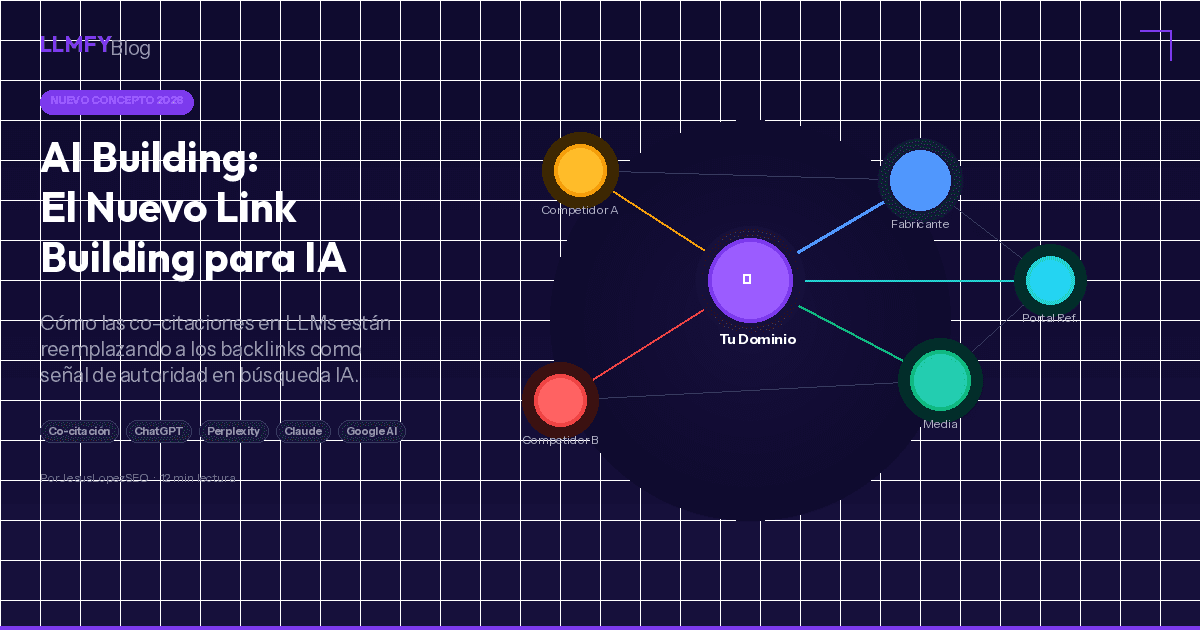
AI Building is the practice of building perceived authority in the eyes of language models by analyzing and optimizing your co-citation neighborhood. That's the cluster of websites that AI mentions alongside yours when answering questions about your industry.
In traditional link building, the key question was "Who links to my site?" In AI Building, the question changes completely: "Who does the AI cite alongside me when it talks about my industry?"
Picture this. Someone asks ChatGPT "What's the best flooring for a residential garage?" The model generates a response and mentions several domains. If your site shows up next to well-known manufacturers, specialized media, and trusted reference guides in your sector, the LLMs reinforce your position as a reliable source. But if you're appearing alongside generic directories or sketchy low-quality sites... your perceived authority takes a serious hit.
That group of domains the AI associates with you is your co-citation neighborhood. And looking after that neighborhood is, in a nutshell, what AI Building is all about.
From Backlinks to Co-Citations: Why the Model Has Changed Entirely
Let me add some technical context here, because this really deserves it.
Traditional SEO is built on a link graph. Each backlink serves as an edge connecting two nodes—two websites—and Google uses PageRank-derived algorithms to distribute authority across that network. It's an elegant model, and it's served us remarkably well for a long time.
LLMs work differently. When a model generates a response, it draws from its training data and, in many cases, runs real-time searches through RAG (Retrieval-Augmented Generation). The model synthesizes information from multiple sources and cites them together within the same response.
That process creates an entirely new type of relationship between websites: AI co-citation.
What does a co-citation actually look like? It happens when two or more domains appear mentioned in the same LLM response for a specific query. The key difference from a backlink is fundamental: a backlink is a direct relationship between two sites (you link to me, I receive authority). A co-citation, on the other hand, is a contextual relationship created by the model itself. The AI has decided that both domains are relevant to the same question. Nobody placed a link on purpose.
And the implications of this are profound.
What the Data Says About Co-Citation and Perceived Authority
I like backing up what I say with numbers, so here are a few that I find particularly eye-opening.
Recent research on LLM citation patterns shows that brand search volume has a 0.334 correlation with citations in language models. That significantly outperforms backlinks as a predictive signal. And here's another stat that really made me think: sites that are cited across four or more AI platforms are 2.8 times more likely to be mentioned consistently by ChatGPT.
In plain English: LLMs care less about who links to you and much more about who they associate you with.
How the Co-Citation Neighborhood Actually Works (With a Real Example)
I'm going to walk you through an example I use frequently in my presentations because I think it makes the concept crystal clear.
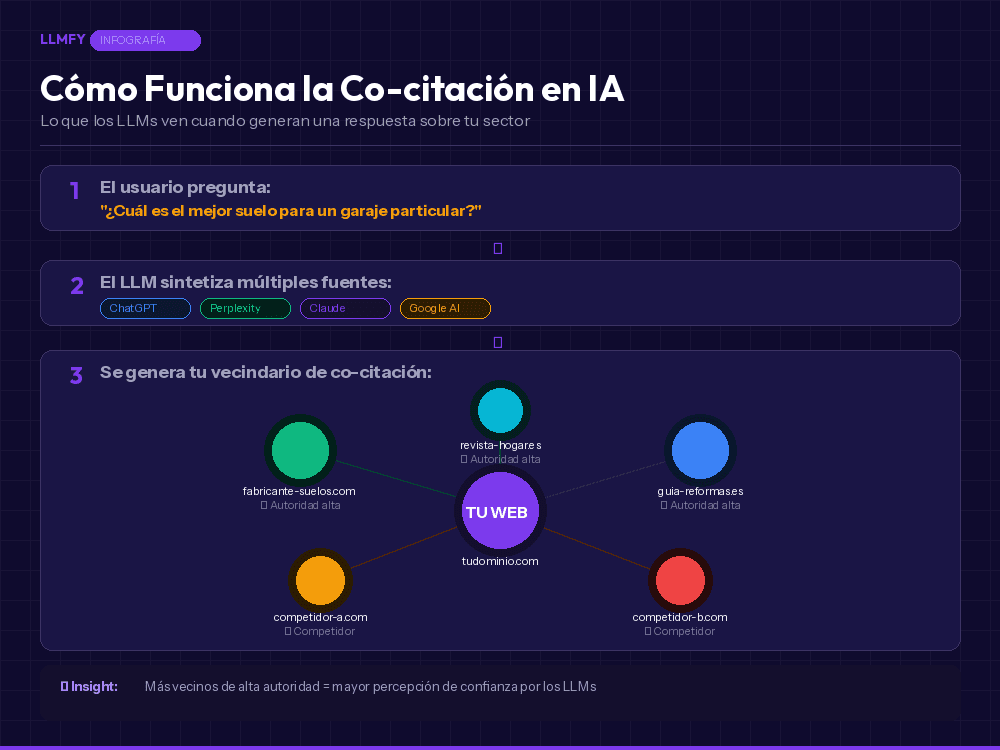
Say you run an online store selling flooring. A user asks ChatGPT "What type of flooring is best for a private garage?" The model might cite three domains in its response: yours, a well-known flooring manufacturer, and a reputable home renovation portal.
Those three domains form your co-citation neighborhood for that specific query. But here's the interesting part—your neighborhood isn't fixed. It shifts depending on the question, the platform, and even the time of day.
When I work on AI Building strategies with my clients, I focus on analyzing these patterns to answer several critical questions:
Who are your regular neighbors? These are the domains the AI repeatedly associates with you. If they're strong, authoritative sites in your industry, you're on the right track. If they're direct competitors, you're in a visibility battle—and you'd better know about it.
Where do you appear in the response? Being the first source mentioned by the LLM is not the same as showing up in third or fourth position. Your position within the response reflects the relevance the model attributes to you. Think of it like Google rankings, but inside a conversational answer.
Does it vary across platforms? This genuinely fascinated me when I first started digging into it. ChatGPT, Perplexity, Claude, and Gemini exhibit quite different citation behaviors. ChatGPT tends to prioritize encyclopedic authority; Perplexity leans toward recent content and community discussions; Google AI Overviews typically cites more diversified sources. Understanding these differences completely changes your approach.
Are there hidden link building opportunities? If a domain consistently appears as your co-citation neighbor but doesn't link to you... that's a prime candidate for outreach. It's an insight traditional link building simply doesn't give you.
AI Building vs. Link Building: The Key Differences
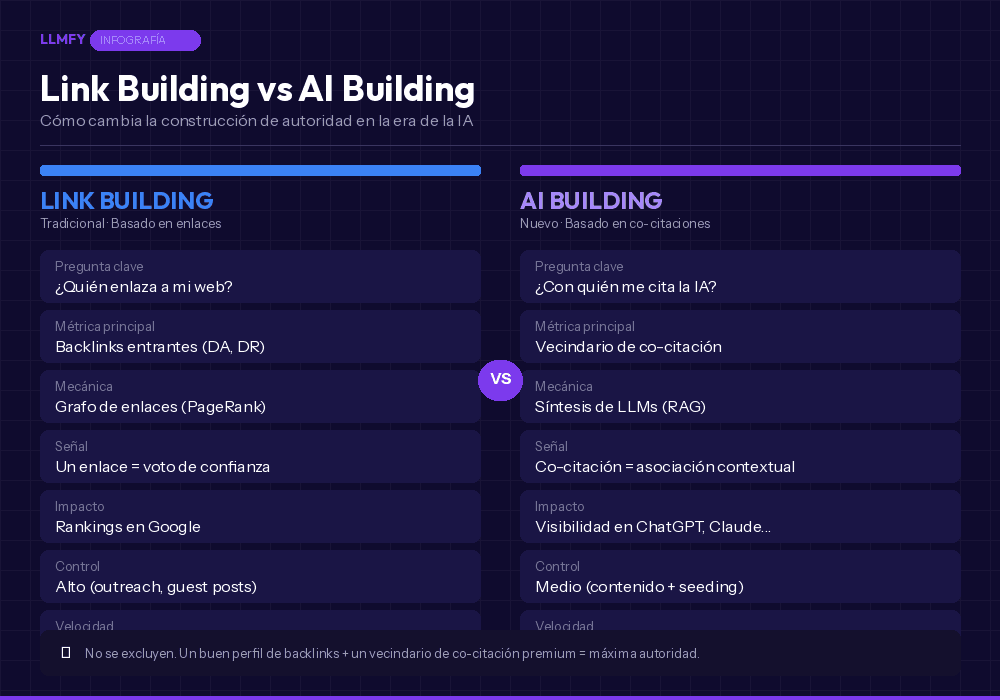
To make the distinction between these two disciplines really clear, let me put things in perspective.
Link building focuses on getting other sites to link to you. Your primary metric is the number and quality of incoming backlinks. The underlying mechanism is the web's link graph—the famous PageRank—where each link equals a direct vote of confidence. You measure the impact through Google rankings.
AI Building focuses on something different: appearing alongside authoritative sites within LLM responses. Your primary metric shifts to your co-citation neighborhood and your position within each response. The mechanism is no longer a link graph but the synthesis patterns of language models. Each co-citation equals a contextual association created by the AI itself. And you measure the impact through visibility in ChatGPT, Perplexity, Claude, and Google AI.
Now—and I want to be very clear about this—these disciplines aren't mutually exclusive. A solid backlink profile still matters, partly because LLMs with real-time search capabilities (RAG) pull from Bing and Google results. But backlinks alone aren't enough anymore. You also need language models to associate you with the right sources.
Five Practical AI Building Strategies You Can Start Using Today
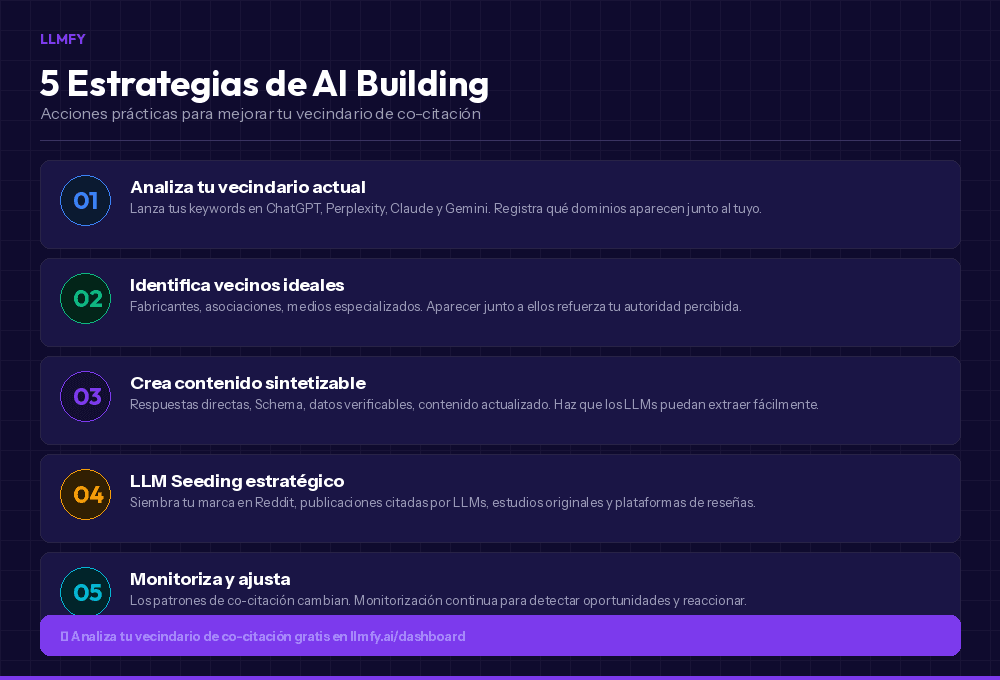
Theory is fine, but execution is what actually matters. These are the five strategies I'm implementing with my clients right now that are producing the best results.
1. Audit your current neighborhood
Before you optimize anything, you need to know where you stand. What I do—and what I recommend—is run the same queries your potential customers would ask on ChatGPT, Perplexity, Claude, and Gemini. Write down which domains appear alongside yours and how often. Look for patterns: are you always showing up next to the same competitors? Are there authoritative sites you're never co-cited with? That information is gold.
2. Identify who your ideal neighbors should be
Not all neighbors carry the same weight. Your ideal neighbors are high-authority sites in your niche that aren't direct competitors: manufacturers, industry associations, specialized media, reference portals. Showing up alongside them reinforces your own perceived authority. It's a bit like attending a networking event—it matters a lot who people see you standing next to.
3. Create content that AI can easily synthesize
LLMs cite content that's easy for them to extract and summarize. That means structuring your pages with direct answers to specific questions, using unambiguous headings, including verifiable data, and implementing structured data (Schema) so AI crawlers properly understand your content. And something people often forget: keep everything up to date. Language models prioritize recent sources, so that article you wrote in 2019 and haven't touched since? It's probably not helping you as much as you think.
4. Practice strategic LLM Seeding
I love this concept for its simplicity. It's about "planting" information about your brand in the sources that LLMs frequently consult. Which sources? Reddit, specialized forums in your industry (with genuine, useful contributions—not spam), publications the models already cite, and review platforms. It's also crucial to create your own proprietary data and original studies that others will want to reference. If you generate unique information, you become a primary source. And LLMs absolutely love primary sources. For the full playbook on placing content on those platforms, see our guide to parasite AI SEO.
5. Monitor and adjust continuously
AI Building isn't a set-it-and-forget-it kind of thing. Co-citation patterns shift constantly as models get updated and new content enters the picture. You need ongoing monitoring to catch changes in your neighborhood, spot new opportunities before your competitors do, and react quickly when someone displaces you.
How Do You Measure Authority in AI Building?
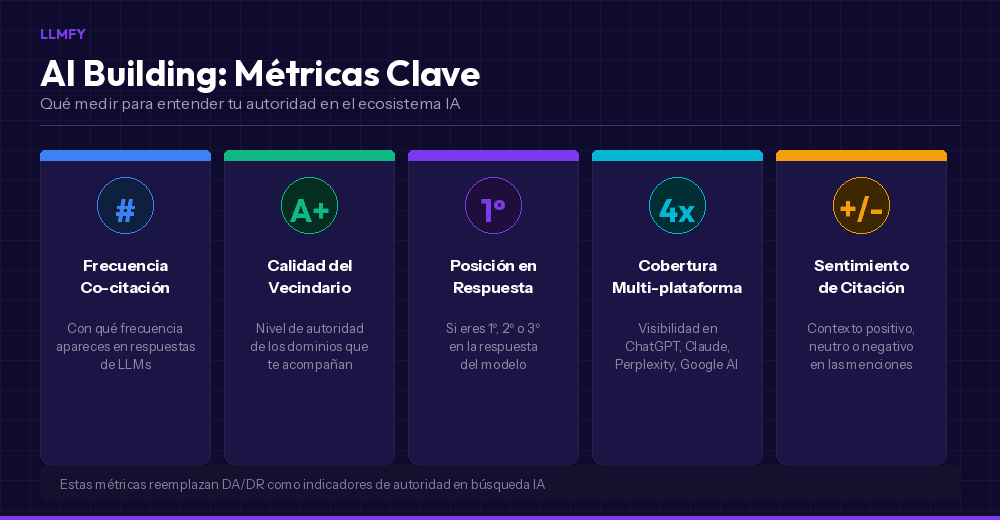
The traditional SEO metrics we're all familiar with—Domain Authority, Domain Rating, backlink counts—don't reflect your authority in the AI ecosystem. Period. For AI Building, you need to look at different things entirely.
Co-citation frequency. How often do you appear in LLM responses for the keywords you care about? More presence means greater recognition. Pretty straightforward.
Neighborhood quality. Are the domains appearing alongside yours high-authority or low-quality? A "premium" neighborhood elevates you; a generic one drags you down.
Position within the response. Are you the first source the model mentions, or the last? Position matters because it reflects the priority the LLM assigns to your content. Being presented first versus being tacked on at the end—those are very different things.
Multi-platform coverage. Do you show up in ChatGPT, Perplexity, Claude, and Google AI, or just one of them? Cross-platform presence indicates much stronger authority. If only one model cites you, it could be a fluke. If four do, you've earned it.
Co-citation sentiment. Is the context in which you're mentioned positive, neutral, or negative? It's not enough to just appear; what matters is how you appear. If the AI cites you as a cautionary example... you'd be better off not showing up at all.
How We're Tackling This at LLMFY
At LLMFY, we've built what I believe is the first tool that lets you analyze and optimize your co-citation neighborhood systematically. And I'm not saying this as a marketing tagline—I'm saying it because we spent months banging our heads against the wall to make it work properly.
Our AI Building feature directly queries the major LLMs—ChatGPT, Claude, and Perplexity—with your target keywords. It analyzes which domains appear alongside yours in each response and gives you a co-citation neighbor map, an AI authority score per keyword, link building opportunities based on co-citation data, and the evolution of your neighborhood over time.
Combined with our Prompt Tracker (which analyzes your visibility across five LLM platforms simultaneously) and LLM Tracking (which monitors your brand mentions in AI), you get a fairly comprehensive suite for understanding and improving your presence in AI-powered search.
The Future of Ranking Is Contextual
I'll wrap up with a thought I keep repeating to anyone who'll listen.
Link building isn't dead. It would be irresponsible to claim that. But it's no longer sufficient on its own. We live in a moment where billions of people are getting answers directly from ChatGPT, Perplexity, and Google AI. In that landscape, authority is no longer measured solely by who links to you—it's measured by who the AI associates you with.
AI Building is the natural evolution of link building for the language model era. And the SEO professionals who grasp this first—the ones who stop obsessing exclusively over backlinks and start paying attention to their co-citation neighborhood—are going to have a competitive advantage that will be extremely tough to replicate.
The question you should be asking yourself today is no longer "How many backlinks do I have?" The question is far more telling: "Who does the AI cite me alongside?"
Curious about what your co-citation neighborhood looks like? Try LLMFY for free and discover which domains the AI associates with you. You might be surprised by what you find.