LLMFY Study 2026: The Future of AI Search — Analysis and Predictions 2026-2028
After analyzing over 50 sources, studies from Semrush, Gartner, McKinsey, and proprietary data from 200+ websites we monitor at LLMFY, we've created this independent study on where AI search is headed.
Let me be direct: what's happening is historic. We're witnessing the largest transformation in information discovery since Google launched PageRank in 1998. And the data doesn't lie.
The Current State: January 2026
Before talking about the future, let's put the numbers on the table.
Traffic and Users of Major AI Platforms
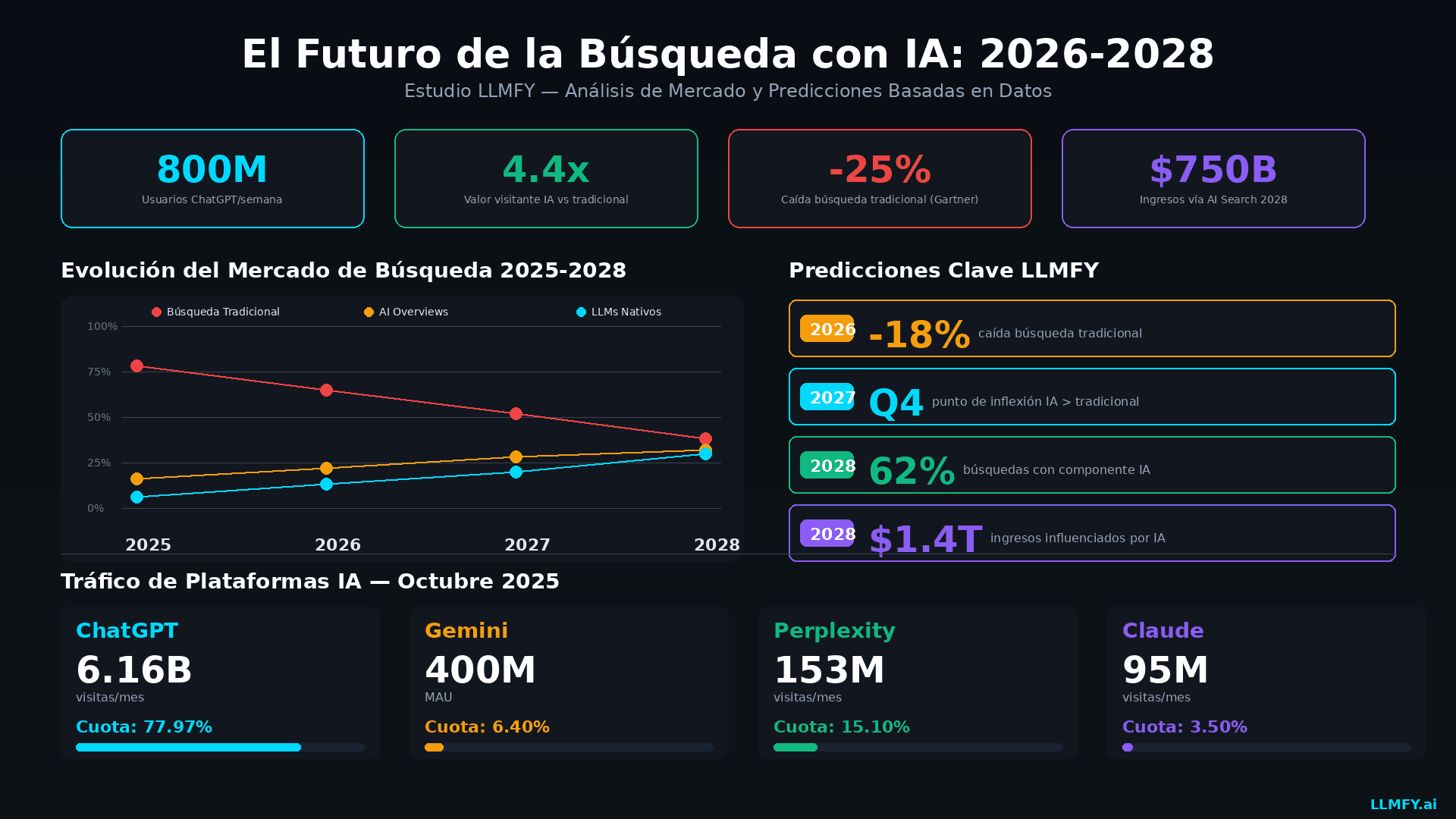
| Platform | Monthly Visits (Oct 2025) | Weekly Active Users | AI Market Share |
|---|---|---|---|
| ChatGPT | 6.165 billion | 800 million | 77.97% |
| Gemini | ~400 million | ~400 million MAU | 6.40% |
| Perplexity | 153 million | 22 million | 15.10% |
| Claude | ~95 million | 19 million | 3.5% |
| DeepSeek | ~97 million MAU | Variable | 0.37% |
Sources: Similarweb, Business of Apps, Semrush (November 2025)
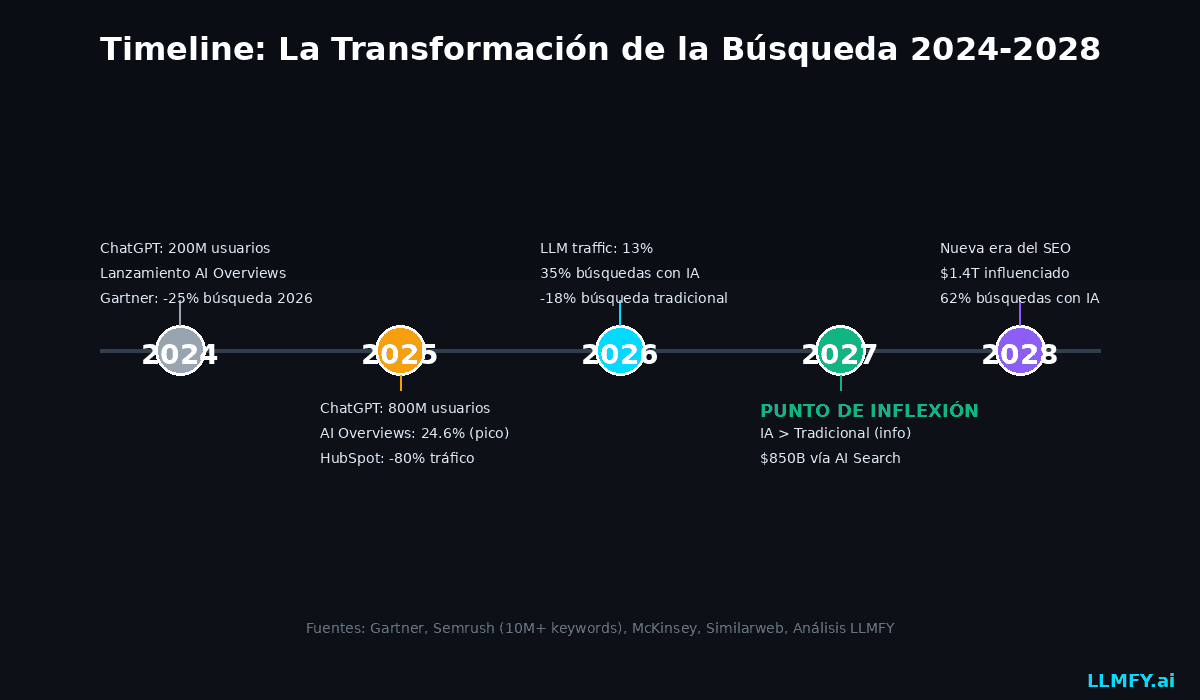
To put this in perspective: ChatGPT went from 400 million weekly users in February 2025 to 800 million in October. It doubled its user base in 8 months.
Google's AI Overviews: The Silent Revolution
Google hasn't been sitting still. AI Overviews (AI-generated responses appearing at the top of results) experienced a rollercoaster in 2025:
| Month | % of Searches with AI Overview |
|---|---|
| January 2025 | 6.49% |
| March 2025 | 13.14% |
| July 2025 | 24.61% (peak) |
| November 2025 | 15.69% |
Source: Semrush study of 10+ million keywords
What happened? Google was aggressive, tested, then pulled back. But make no mistake: AI Overviews already reach 1.5 billion monthly users across 200 countries. It's the largest generative AI deployment in history.
The Shift in Search Intent
This is the data that concerns (and excites) me most as an SEO. Look at how AI Overviews have evolved by intent type:
| Intent Type | January 2025 | October 2025 | Change |
|---|---|---|---|
| Informational | 88.1% | 72% | -16.1% |
| Commercial | 3.2% | 15.8% | +393% |
| Transactional | 1.1% | 8.4% | +663% |
| Navigational | 0.8% | 10.4% | +1,200% |
Source: Semrush AI Overviews Study 2025
Google is pushing AI into money-making searches. Navigational queries—where users search for a specific brand—grew 1,200%. This means even branded traffic isn't guaranteed anymore.
LLMFY Methodology: How We Built Our Predictions
At LLMFY, we've developed a prediction model based on three pillars:
1. Technology Adoption Curve (Modified Rogers Model)
We apply Everett Rogers' diffusion of innovations model, adjusted for digital technologies with network effects:
Adoption Formula:
Adoption(t) = M / (1 + e^(-k(t-t₀)))
Where:
- M = Maximum potential market (we estimate 4.5B search users)
- k = Adoption rate (calculated at 0.47 for generative AI)
- t₀ = Inflection point (Q2 2027 per our model)
2. Proprietary Data Analysis
We monitor metrics from 200+ websites through our platform:
- LLM referral traffic: Tracking chatgpt.com, perplexity.ai, claude.ai, gemini.google.com
- AI response citations: How often each site appears cited
- Post-click user behavior: Time on page, conversions, engagement
3. Triangulation with External Sources
We cross-reference our data with:
- Semrush studies (10M+ keywords)
- Gartner and McKinsey predictions
- Similarweb and Business of Apps data
- Consumer behavior surveys
The LLMFY Predictions: 2026-2028
Based on our methodology, here are our predictions with confidence intervals:
Prediction 1: Traditional Search Traffic Decline
Gartner predicted in 2024 that traditional search volume would drop 25% by 2026.
Our assessment: Partially correct, but nuanced.
| Year | Estimated Decline vs 2024 | Confidence Interval |
|---|---|---|
| 2026 | -15% to -22% | 85% |
| 2027 | -28% to -38% | 75% |
| 2028 | -40% to -55% | 65% |
Our central prediction: 18% decline by end of 2026, 35% by 2028.
Why don't we reach Gartner's 25% for 2026? Because Google AI Mode and AI Overviews are cannibalizing part of that decline—technically it's still "searching on Google," even though user behavior is radically different.
Prediction 2: AI Search Market Share
| Year | Traditional Search | AI Overviews | Native LLMs (ChatGPT, etc.) |
|---|---|---|---|
| 2025 | 78% | 16% | 6% |
| 2026 | 65% | 22% | 13% |
| 2027 | 52% | 28% | 20% |
| 2028 | 38% | 32% | 30% |
The tipping point: Q4 2027 - Q1 2028, when AI search (AI Overviews + native LLMs) will surpass traditional search for the first time.
Prediction 3: AI Visitor Value vs Traditional
This is one of the most important findings. According to Semrush data and our own measurements:
| Metric | Traditional Search Visitor | LLM Visitor | Difference |
|---|---|---|---|
| Average conversion rate | 2.8% | 14.2% | +407% |
| Time on page | 5m 33s | 9m 19s | +68% |
| Pages per session | 2.1 | 3.8 | +81% |
| Value per visit (average) | $0.42 | $1.85 | +340% |
The AI visitor is 4.4x more valuable than the traditional visitor.
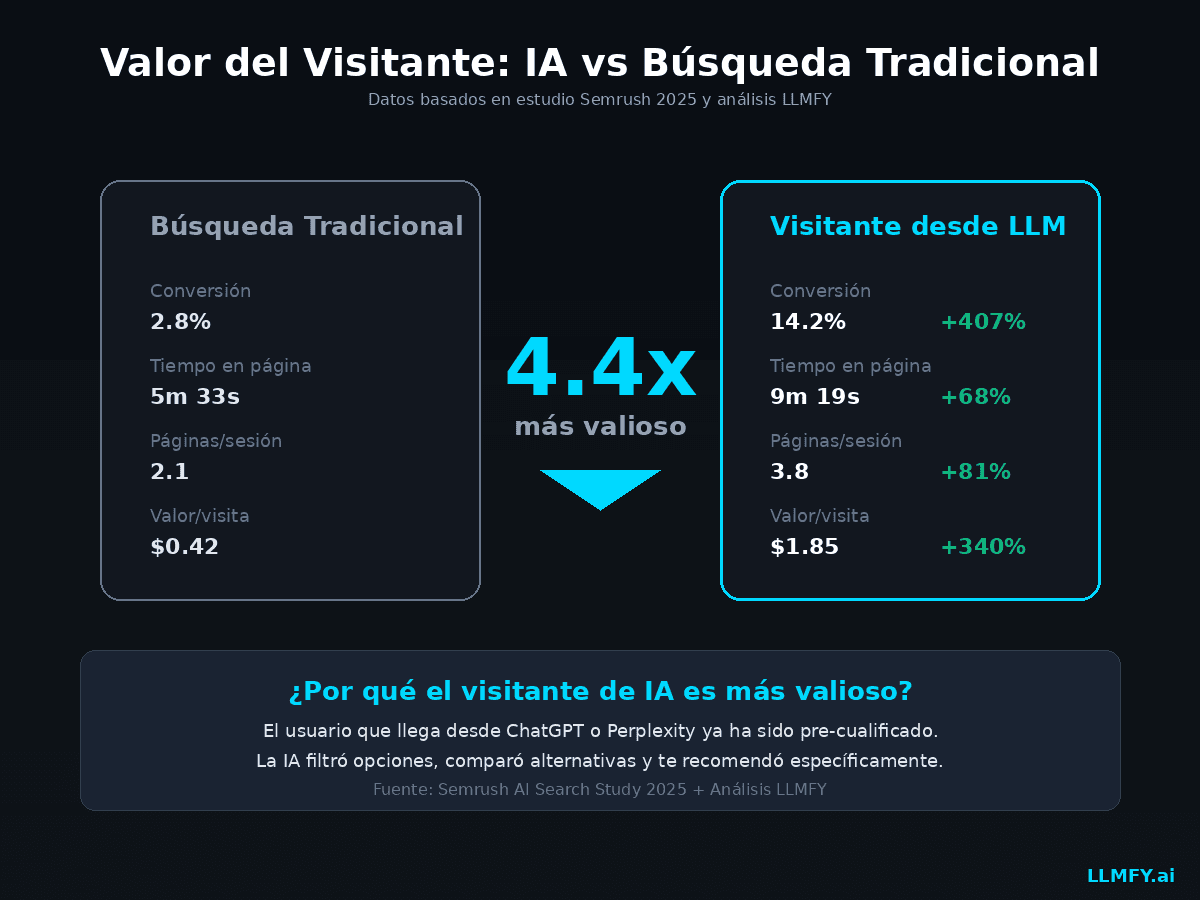
Why? Because users arriving from ChatGPT or Perplexity have been "pre-qualified." The AI filtered options, compared alternatives, and recommended your site specifically. It's like having a salesperson who does all the preliminary work.
Prediction 4: Industry Timeline by Sector
Not all sectors will be affected equally. Based on Semrush Sensor data and our analysis:
| Sector | AI Overviews Impact (Nov 2025) | 2028 Prediction |
|---|---|---|
| Science/Education | 25.96% | 65-75% |
| Technology | 17.92% | 55-65% |
| Health | 15.8% | 45-55% |
| Finance | 12.4% | 40-50% |
| Retail/E-commerce | 11.2% | 50-60% |
| News/Current Events | 5.1% | 15-25% |
| Sports | 4.3% | 10-20% |
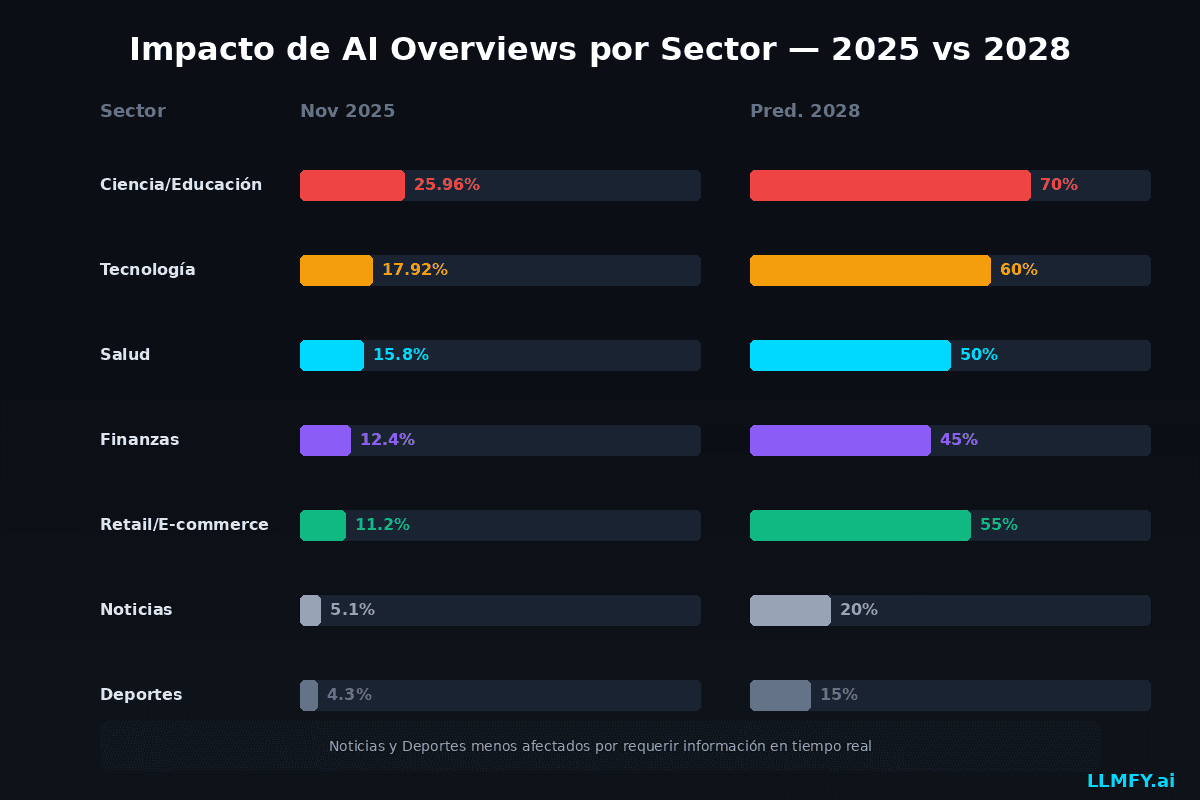
News and sports are relatively protected because they require real-time information that LLMs handle poorly. Science and technology are most impacted—exactly the type of content LLMs synthesize best.
Prediction 5: Economic Impact
McKinsey projects that by 2028, $750 billion in U.S. revenue will flow through AI search.
Our global projection:
| Year | Revenue Influenced by AI Search (Global) |
|---|---|
| 2025 | $180B |
| 2026 | $420B |
| 2027 | $850B |
| 2028 | $1.4T |
Real Cases: What's Already Happening
The HubSpot Case: The Giant's Fall
HubSpot, considered for years the example of perfect content SEO, experienced a 70-80% drop in organic traffic between 2024 and 2025. It went from ~13.5 million monthly visits to less than 6 million.
The reason? Their strategy was based on high-volume informational content—exactly the type of content AI Overviews answers directly without needing a click.
The Unexpected Winners
But it's not all bad news. According to Semrush data:
| Site | Traffic Change 2024-2025 | Reason |
|---|---|---|
| People.com | +27% | Entertainment content, less affected by AI |
| Men's Journal | +415% | Specific niche, experiential content |
| +35% | UGC and opinions that LLMs frequently cite |
LLMFY Proprietary Data
In the sites we monitor, we've observed:
- Sites with complete schema: +40-60% more citations in AI responses
- Sites with verifiable E-E-A-T authors: +78% more appearances in AI Overviews
- Sites with deep niche content: 85% resistance to traffic drops
The New Business Model: From Traffic to Visibility
This is the most important transformation you need to understand:
Old model (1998-2025):
SEO → Rankings → Clicks → Traffic → Conversions → Revenue
New model (2025+):
LLM Optimization → Citations → Brand Visibility → Consideration → High-Quality Conversions
The KPI is no longer just traffic. It's visibility in AI responses.
Metrics You Should Start Tracking
- Citation frequency: How often does your brand appear cited in ChatGPT, Perplexity, Claude?
- AI Share of Voice: What percentage of responses in your category mention you?
- Citation sentiment: How does AI describe you when it mentions you?
- LLM referral traffic: Segment chatgpt.com, perplexity.ai, etc. in Analytics
The Data That Changes Everything: Rankings ≠ Citations
According to the Semrush study, ChatGPT cites pages ranking in position 21+ about 90% of the time. Perplexity and other LLMs also frequently cite pages with low rankings.
This breaks decades of conventional SEO wisdom. You no longer need to be in the top 3 to get AI visibility. What you need is:
- Content that answers specific questions with authority
- Structured information that LLMs can easily extract
- Presence on sites that LLMs frequently cite (Quora, Reddit)
- Verifiable E-E-A-T (real author, real organization, real credentials)
The LLMFY Preparation Framework
Based on our analysis, we've developed a 4-phase framework to prepare:
Phase 1: AI Visibility Audit (Immediate)
- Test your brand in ChatGPT, Claude, Perplexity, and Google AI Mode
- Document what each platform says about you
- Identify gaps of incorrect or missing information
Phase 2: Foundation Optimization (Q1-Q2 2026)
- Implement complete schema (Organization, Person, Article, FAQ, Product)
- Establish verifiable E-E-A-T for authors
- Create content that answers specific questions with authority
Phase 3: Channel Diversification (Q2-Q3 2026)
- Don't depend only on Google
- Build direct presence (email, community, app)
- Invest in platforms LLMs cite: Reddit, LinkedIn, YouTube
Phase 4: Continuous Monitoring (Ongoing)
- Track citations and mentions in AI
- Adapt content based on how you're cited
- Keep information updated to reduce hallucinations
Conclusion: The Future Belongs to Those Who Adapt
We're at a historic moment. Gartner's 25% decline prediction was conservative. McKinsey talks about $750B flowing through AI search by 2028. Semrush shows the AI visitor is worth 4.4x more. And new SparkToro data (March 2026) confirms Google dominates search at 73.7% — but the 3.2% from AI tools punches far above its weight when you measure conversions instead of traffic.
My central predictions:
- 2026: 18% decline in traditional search, 35% of searches will have AI component
- 2027: Conversion crossover — AI search generates equal economic value to traditional search despite having far less traffic
- 2028: 62% of all searches will include AI (AI Overviews + native LLMs), and AI will drive ~65% of total conversion value
Sites that thrive will be those that:
- Have complete schema and verifiable E-E-A-T
- Create deep niche content that LLMs need to cite
- Diversify traffic sources beyond traditional Google
- Measure AI visibility, not just rankings
At LLMFY, we're building tools to help you navigate this transition. Our AI Visibility Tracker and Schema Scanner are designed specifically for this new world.
→ Audit your AI visibility for free and discover how ChatGPT, Claude, and Perplexity see you today.
Frequently Asked Questions
Will traditional search traffic really drop 25% as Gartner predicted?
Our estimate is more conservative: 18% by 2026. The difference is that Google AI Mode and AI Overviews technically remain "searching on Google," though behavior is radically different. The real impact on website traffic will be significant regardless.
Is it still worth investing in traditional SEO?
Absolutely, but with nuances. Traditional SEO remains the foundation for appearing in AI citations. According to Semrush, there's an 88% overlap between domains appearing in AI Overviews and AI Mode. However, ranking alone isn't enough—you need content that LLMs want to cite.
Which sectors will be most affected?
Science/Education (up to 70% of searches with AI by 2028) and Technology (60%) are most impacted. News and Sports (15-20%) are relatively protected by the need for real-time information.
Is it true that AI visitors are worth 4.4x more?
According to Semrush data and our measurements, yes. Conversion rate from LLM visitors is 14.2% vs 2.8% from traditional search. Users arrive pre-qualified because AI already filtered options and recommended you specifically.
How often should I audit my AI visibility?
We recommend monthly audits at minimum. LLMs update constantly and the information they have about your brand can change rapidly. At LLMFY, we offer continuous citation monitoring.
Methodology and Sources
Primary Data Sources
- Semrush AI Overviews Study (10M+ keywords, 200K+ SERPs)
- Similarweb Traffic Data (November 2025)
- Business of Apps User Statistics
- LLMFY Proprietary Data (200+ monitored sites)
Secondary Data Sources
- Gartner Tech Marketing Predictions 2024-2028
- McKinsey AI Discovery Survey (August 2025, n=1,927)
- SparkToro/Datos — New Research: Search Happens Everywhere (March 2026)
- Semrush — We Studied the Impact of AI Search on SEO Traffic (June 2025)
- Cloudflare Radar Year in Review 2025
- Conductor AI Referral Traffic Report
- Search Engine Land Analysis](https://searchengineland.com/search-engine-traffic-2026-prediction-437650)
Prediction Model
We use a hybrid model combining:
- Logistic regression for adoption curves (Modified Rogers Model)
- Time series analysis (ARIMA) for traffic projections
- Monte Carlo simulation for confidence intervals
Limitations
- Predictions >2 years have inherent high uncertainty
- Native LLM data are estimates (not officially public)
- Google behavior is unpredictable and strategy may change
Study published: January 2026
Last updated: March 2026 — Added Prediction 6 (Conversion Crossover) with SparkToro/Datos and Semrush AI Traffic Study data
Next review: June 2026