Best AI SEO Tools in 2026: 12 Platforms Tested for LLM Visibility, GEO & AI Search Optimization
I've been doing SEO for over 18 years, and I've never seen the tooling landscape change as fast as it has in the last 12 months. Every week there's a new platform claiming to be "the AI SEO tool" — but after testing dozens of them, I can tell you that most are either repackaged content spinners or traditional SEO tools with an AI label slapped on top.
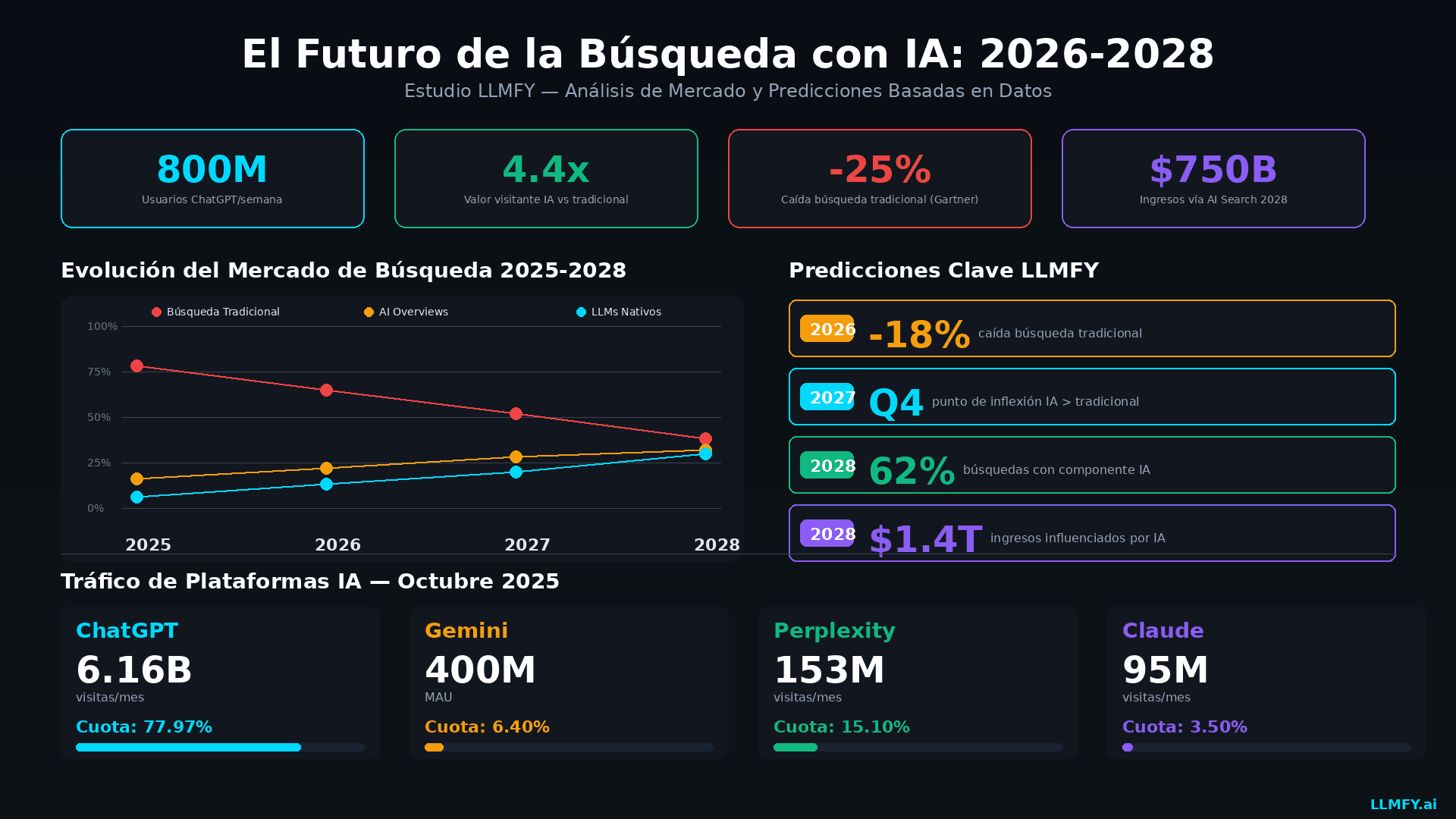
Here's the thing nobody in these roundup articles wants to say: the real shift in 2026 isn't about AI writing your content. That ship has sailed. It's about AI search engines becoming a primary discovery channel — and most businesses haven't even noticed. Over 800 million people use ChatGPT weekly. Google AI Mode is reshaping organic results as we know them. Perplexity and Claude are answering questions that used to drive clicks to your site.
The question is no longer "do I rank on Google?" It's "does AI even know I exist?"
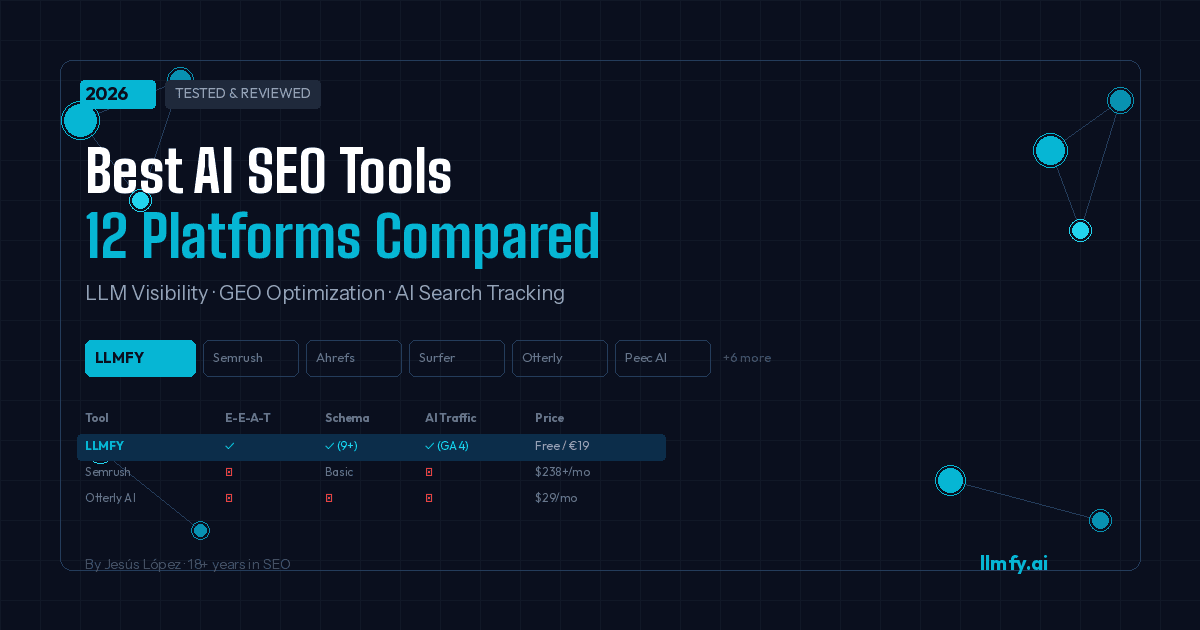
I built LLMFY because I needed an answer to that question for my agency clients and no tool gave me one. But I'm not going to pretend it's the only game in town. In this guide I'll walk you through 12 AI SEO tools I've personally used — what they actually do well, where they frustrate me, and which one fits depending on what you're trying to accomplish.
Full disclosure before we start: LLMFY is my product and it's listed first. I'm completely transparent about that. But I've spent serious time with every tool on this list and I've included honest criticisms of my own platform too, because that's the article I'd want to read if I were in your shoes.
What actually matters when picking an AI SEO tool
Before diving into the list, let me save you some time. After 18 years in SEO and building my own LLMO platform from scratch, I've learned that most "AI SEO tool" comparison articles evaluate the wrong things. They compare number of features, UI screenshots, and pricing tiers. That's fine for traditional SEO tools, but AI SEO is a fundamentally different problem. Here's what I actually look for:
LLM Visibility Tracking — Can the tool show you how your brand appears in ChatGPT, Perplexity, Claude, Gemini, and Google AI Mode? This is table stakes. If a tool calls itself "AI SEO" but only tracks traditional Google rankings with an AI-generated summary on top, it's 2024 thinking wearing a 2026 costume.
On-page optimization for AI — Does it help you improve what AI actually evaluates? That means E-E-A-T signals, schema markup, semantic structure, and citability — not just keyword density wrapped in fancier packaging.
AI Traffic measurement — Can you connect your analytics and see real sessions and conversions from AI sources? I'm shocked by how few tools offer this. Without it, you're optimizing blind and reporting on vibes.
Actionability — Data without recommendations is a dashboard, not a tool. I want something that tells me what to fix, in what order, and why it matters for AI specifically.
Pricing transparency — The AI SEO space has become notorious for hidden costs and confusing add-on structures. I note every pricing model clearly because I've been burned by "starting at" prices that double once you need the features that actually matter.
The 12 best AI SEO tools for 2026
1. LLMFY — Best all-in-one for LLM Optimization (LLMO)
Website: llmfy.ai
Pricing: Free plan (3 analyses) | From €19/month | Pro €99/month
Best for: SEOs, agencies, and businesses that want to optimize their site for AI search — not just track it
I built LLMFY because I was tired of stitching together Python scripts and ChatGPT prompts to audit how AI search engines perceive my clients' sites. I'd spend hours running manual checks across five different LLMs, copying results into spreadsheets, and trying to find patterns. The tools that existed either only tracked mentions (useful but like reading a thermometer without knowing how to bring the fever down) or were traditional SEO suites with an AI add-on at $99+/month extra that felt like an afterthought.
LLMFY is built from scratch for the AI search era. It's not a feature bolted onto legacy SEO software — every single tool is designed around one question: how do LLMs see your content, and what specific things can you do to change that?
The 11 tools inside LLMFY and what each actually does:
E-E-A-T Auditor — This is the tool I'm most proud of. It analyzes the Experience, Expertise, Authority, and Trust signals that AI models prioritize when selecting sources to cite. But unlike generic "E-E-A-T score" tools, it breaks down exactly which signals are strong, which are missing, and gives you a prioritized list of specific fixes. For one client, simply adding author credentials and organization schema based on the audit recommendations improved their AI citability score by 15% in three months.
Schema Scanner — Detects 9+ types of structured data and tells you which schemas are missing for AI comprehension. Product, Organization, FAQ, HowTo, Review — each one affects how AI agents understand and recommend your content. Most sites I audit are missing at least 3-4 critical schema types.
Semantic Analyzer (AIO) — Compares your semantic relevance against top competitors for any topic. This is where you discover why a competitor with fewer backlinks keeps getting cited while you don't — usually it's a content gap that's invisible to traditional SEO tools.
LLM Citability Score — A proprietary score that estimates how likely your content is to be cited by LLMs. This is the metric I wish had existed when I started doing LLMO work for clients. It synthesizes E-E-A-T, schema, semantics, and content structure into a single number you can track over time.
LLM Tracking — Monitor how your brand appears in AI responses over time. Track mentions, position, and visibility evolution across ChatGPT, Perplexity, Claude, and Google AI.
Brand Sentiment — Discover how AI search engines perceive and recommend your brand. Positive, negative, neutral — broken down by platform. One of our clients discovered that Claude consistently described their brand negatively due to an outdated review that was being heavily cited.
Prompt Tracker — Analyze how the main LLMs respond to your key prompts. See your position and which competitors are co-cited alongside you in Google, ChatGPT, Perplexity, Claude, and Gemini. This is incredibly revealing — you often discover competitors you didn't even know you had.
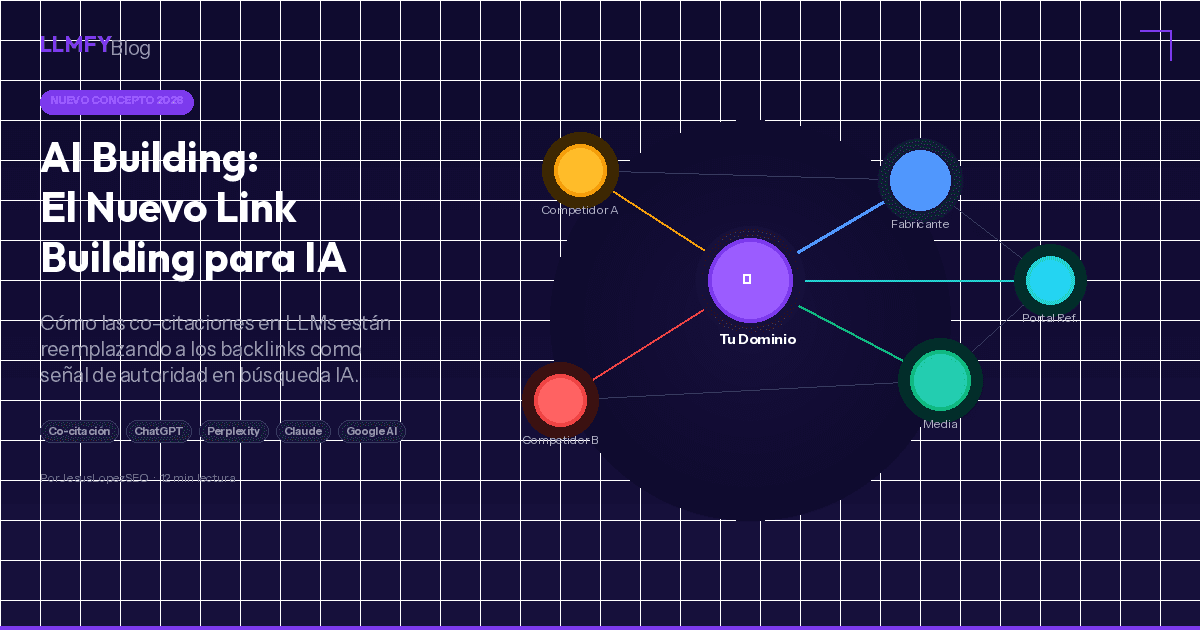
AI Building — Discover which domains appear alongside yours in LLM responses. Find link building opportunities based on AI co-citation authority — a completely new approach to link building that traditional tools can't replicate.
AI Traffic Analytics — Connect Google Analytics and measure real traffic from AI search engines. Sessions, conversions, eCommerce revenue — all broken down by ChatGPT, Perplexity, Gemini, Claude vs. traditional organic. This is the feature that makes CFOs pay attention, because it puts a revenue number on AI search optimization.
Robots.txt Optimizer — Analyze your robots.txt for AI bot visibility. Supports GPTBot, ClaudeBot, PerplexityBot, and 10+ AI crawlers. You'd be surprised how many sites are accidentally blocking AI bots.
Bing IndexNow — Instant indexing for faster AI discovery. Push URLs directly to Bing for rapid crawling when you make changes.
What I'd honestly tell a friend: If your primary concern is understanding how LLMs perceive your content and getting specific, actionable fixes — LLMFY is the most comprehensive and affordable option on this list. 11 specialized tools, starting at €19/month, with a free tier that gives you 3 real analyses. The weakness? Traditional SEO features like keyword research and backlink analysis are basic. That's by design — I built LLMFY to fill the gap that Ahrefs and Semrush don't cover, not to replace them. If you need backlinks, pair it with Ahrefs. If you need keyword data, pair it with Semrush. But for the AI side? This is what I built it for.
Start a Free Analysis at LLMFY
2. Semrush — Best for connecting AI visibility with SEO
Website: semrush.com
Pricing: SEO Classic from $139.95/month · AI Visibility Toolkit +$99/month per domain · Semrush One (SEO + AI bundled) from $199/month
Best for: SEO, content, and brand teams that want AI visibility, competitive research, and technical auditing in one platform
Semrush needs no introduction — it's been the go-to for traditional SEO since before most people knew what AI Overviews were. It has since grown into a full search visibility platform that covers classic SEO and AI search in one place. Its AI Visibility Toolkit tracks mentions, citations, sentiment, prompts, and competitor visibility across the major AI platforms, and ties those findings to Semrush's wider keyword, backlink, authority, and technical data.
What makes it more than a tracker is the diagnostic context. Competitor Research shows where rivals surface more often, Prompt Research surfaces topics and citation opportunities, and the AI Search Site Audit flags technical barriers affecting AI crawlers. At the top end, Enterprise AIO adds broader model coverage, multi-brand and multi-market analysis, and traffic and conversion attribution.
The honest caveat is scope and price. If all you want is a basic ChatGPT mention tracker, this is more platform than you need, and the AI side leans toward tracking rather than optimization — there's no dedicated E-E-A-T audit and no schema-optimization workflow, though the proprietary Authority Score measures domain and page quality and Site Audit validates structured data. On pricing you're looking at SEO Classic from $139.95/month, the AI Visibility Toolkit as a $99/month add-on per domain, or both bundled in Semrush One from $199/month. LLMFY goes deeper on AI-specific signals — E-E-A-T, schema, citability, AI traffic — for €19-99/month, so I see them as complementary rather than direct substitutes.
When it makes sense: You want AI visibility living in the same platform as your keyword research, backlinks, authority data, and technical auditing, instead of stitching several tools together.
3. Ahrefs (with Brand Radar) — Best for SEO pros who want AI tracking alongside backlinks
Website: ahrefs.com
Pricing: From $129/month base + $49-99/month Brand Radar add-on
Best for: Link-focused SEOs who want to add basic AI monitoring
Ahrefs is still the king of backlinks. Nobody does link analysis better, period. Their Brand Radar add-on ($49-99/month extra) tracks brand mentions across LLMs, and their keyword research now includes AI intent signals with support for 40+ languages.
What I appreciate about Ahrefs is that they haven't tried to pretend their AI features are something they're not. Brand Radar is a monitoring add-on — it tells you where your brand shows up in AI responses. It's more affordable than Semrush's equivalent and the multi-language support is genuinely useful for international brands.
What bugs me is that the AI features feel bolted on. There's no E-E-A-T analysis, no schema optimization, no semantic analysis for AI. Brand Radar is a separate tab that doesn't really integrate with the core Ahrefs workflow. It's a tracking layer, not an optimization engine.
My recommendation: Keep Ahrefs for what it does best — backlinks and keyword research are unmatched. But don't expect it to solve your AI visibility problems. Pair it with a dedicated LLMO tool for the other half of the equation.
4. Surfer SEO — Best for content optimization with AI visibility
Website: surferseo.com
Pricing: From $99/month
Best for: Content teams that want to optimize for both traditional SERP and AI answers
Surfer started as a content optimization tool and it's still one of the best for that. Their NLP-driven content editor gives you real-time scoring as you write, and now they've added AI visibility monitoring and prompt tracking to the mix.
What Surfer gets right is the workflow. You research a topic, write in the editor, optimize for traditional SERP and AI answers simultaneously, then track how it performs. For content-heavy teams that publish regularly, this is a significant time saver.
Where Surfer falls short for LLMO specifically is depth. The AI visibility features are newer and less mature than dedicated tools. There's no deep E-E-A-T auditing for AI, no schema optimization engine, and no way to measure AI traffic coming to your site. It's content-focused first, AI-aware second.
When to pick Surfer: Your primary job is producing content that needs to rank in both Google and AI answers. For the technical LLMO side (schema, E-E-A-T, citability), you'll need a complement.
5. Otterly AI — Best budget-friendly AI visibility starter
Website: otterly.ai
Pricing: From $29/month (15 prompts) | Standard $189/month
Best for: Small teams exploring AI visibility tracking for the first time
Otterly is the tool I recommend when someone asks "I just want to know if ChatGPT mentions my brand — what's the cheapest way to find out?" Setup takes under 10 minutes, the dashboard is clean, and at $29/month for 15 tracked prompts, it's hard to argue with the price.
It tracks mentions across ChatGPT, Perplexity, Google AI Overviews, and Gemini. The GEO URL audits are a nice touch. For a small team dipping their toes into AI visibility for the first time, this is a perfectly valid starting point.
The limitations are real though. No on-page optimization of any kind — no E-E-A-T, no schema, no semantic analysis. No AI traffic measurement. And the pricing jumps from $29 to $189 once you need more than 15 prompts, which is a steep cliff. There's also no hallucination detection, so if AI is saying wrong things about your brand, Otterly won't flag it.
Think of Otterly as a thermometer, not a doctor. It tells you your temperature but doesn't diagnose or treat. For the "what do I actually fix?" part, you'll need a different tool.
6. Peec AI — Best for competitive benchmarking across AI engines
Website: peec.ai
Pricing: From €89/month (25 prompts) | Pro €199/month | Enterprise €499+/month
Best for: Marketing teams that need competitor comparison in AI visibility
Peec AI is a Berlin-based platform that does competitive benchmarking across AI engines really well. If you're in a competitive market and need to understand exactly how your brand stacks up against rivals in ChatGPT, Perplexity, Claude, Gemini, and Google AI Overviews, Peec gives you a clear picture with daily refreshes and exportable reports.
The UI is clean, onboarding is fast, and the citation source analysis — showing you exactly which sources AI models reference when talking about your brand — is genuinely useful for strategy.
My issue is the value equation. At €89-499/month, you're paying significant money for monitoring alone. There are no optimization tools, no E-E-A-T analysis, no schema scanning, no semantic analysis. Peec tells you where you stand but not how to improve. When LLMFY includes tracking plus 10 optimization tools starting at €19/month, the math is hard to justify unless competitive intelligence is your only need.
7. Profound — Best for enterprise LLM intelligence
Website: profound.ai
Pricing: From $99/month (ChatGPT only) | Enterprise: custom pricing
Best for: Large enterprises that need deep LLM analysis across 10+ models
Profound is the tool I'd recommend to a Fortune 500 CMO who walked into my office and said "I need to understand how AI perceives our brand at a strategic level." Their Conversation Explorer analyzes 400M+ real user prompts — not synthetic test queries, but actual things real people ask AI systems. That's a genuinely unique dataset that nobody else has at that scale. They cover 10+ LLMs with share of voice, sentiment, and citation analysis.
The problem for most businesses? Profound is built for insights, not execution. It won't tell you which schema to add, how to improve your E-E-A-T signals, or help you optimize a single page. It's a strategic intelligence layer, and at enterprise pricing, it's meant for organizations that have separate teams to act on the insights. For a mid-market company or agency, the price-to-action ratio just doesn't work.
8. Writesonic (GEO features) — Best for content-first AI visibility
Website: writesonic.com
Pricing: From $249/month (Professional with AI features)
Best for: Content teams that want AI content creation bundled with GEO tracking
Writesonic has been on an interesting journey — from AI writer to a broader platform that now includes GEO monitoring. Their Chatsonic agent can use GPT-4, Claude, and Gemini for SEO tasks with live data.
The unified approach is appealing: write content, optimize it, track visibility — all in one place. But at $249/month for the plan that includes AI features, it's a big commitment. And the AI content still needs serious human editing.
Pick Writesonic if: You publish at high volume and want content generation plus visibility tracking together. Skip it if technical LLMO optimization is your focus.
9. SE Ranking (with AI Toolkit) — Best all-around platform with AI features
Website: seranking.com
Pricing: From $65/month base
Best for: Teams wanting a comprehensive SEO platform with solid AI additions
SE Ranking has built an impressive platform that integrates traditional SEO with AI features more naturally than most competitors. Their AI Overviews tracker, content optimization, and keyword clustering are well-executed.
Strengths: Excellent value for a full SEO platform. AI features integrated naturally, not as expensive add-ons. Good for multi-project management.
Limitations: AI-specific features less deep than dedicated LLMO tools. No E-E-A-T auditing for AI. Schema optimization is basic.
My take: Best value if you need a traditional SEO platform that also does AI tracking. But for dedicated LLMO optimization, pair it with a specialist tool.
10. Nightwatch — Best for combining traditional rank tracking with AI visibility
Website: nightwatch.io
Pricing: From $49/month
Best for: SEO teams that want to extend existing rank tracking into AI search
Nightwatch takes a practical approach: extend what you already do (rank tracking) into AI search. It connects traditional rankings with AI-generated answer monitoring so you see performance across both worlds in one place.
Strengths: Bridges traditional and AI search tracking naturally. Affordable entry point. Good for teams transitioning from traditional to AI SEO.
Limitations: AI features are an extension of rank tracking, not deep LLMO tools. No on-page optimization for AI. Limited optimization recommendations.
My take: Good choice if you're primarily a rank tracking team that wants to start monitoring AI visibility without a major tooling change.
11. Frase — Best for research-to-publish AI content workflows
Website: frase.io
Pricing: From $45/month
Best for: Content creators who need SERP research, AI writing, and GEO in one workflow
Frase has positioned itself as an "agentic SEO platform" with one AI agent handling research, writing, optimization, and now GEO tracking. They monitor brand visibility across Google and 8 AI platforms.
Strengths: Excellent research-to-publish workflow. Affordable entry. AI agent approach is efficient. Tracks share of voice across ChatGPT, Perplexity, Claude, and more.
Limitations: GEO features are new and still maturing. Content optimization less precise than Surfer or Clearscope. Better for content workflows than technical LLMO.
My take: Great value for content teams on a budget. Pairs well with LLMFY — use Frase for content creation, LLMFY for technical LLMO optimization.
12. AIclicks — Best for action-oriented AI visibility optimization
Website: aiclicks.io
Pricing: From $49/month
Best for: Brands that want optimization recommendations alongside tracking
AIclicks combines AI visibility tracking with actionable optimization suggestions. It monitors how brands appear across ChatGPT, Perplexity, Gemini, Copilot, and Google AI Overviews, then provides recommendations to improve visibility.
Strengths: Combines monitoring with optimization guidance. Tracks across major AI platforms. Good content recommendation engine. Affordable starting price.
Limitations: Newer platform, still building out features. Optimization recommendations can be generic. Less depth than enterprise tools.
My take: Solid option for teams that want monitoring plus basic optimization guidance at an accessible price point.
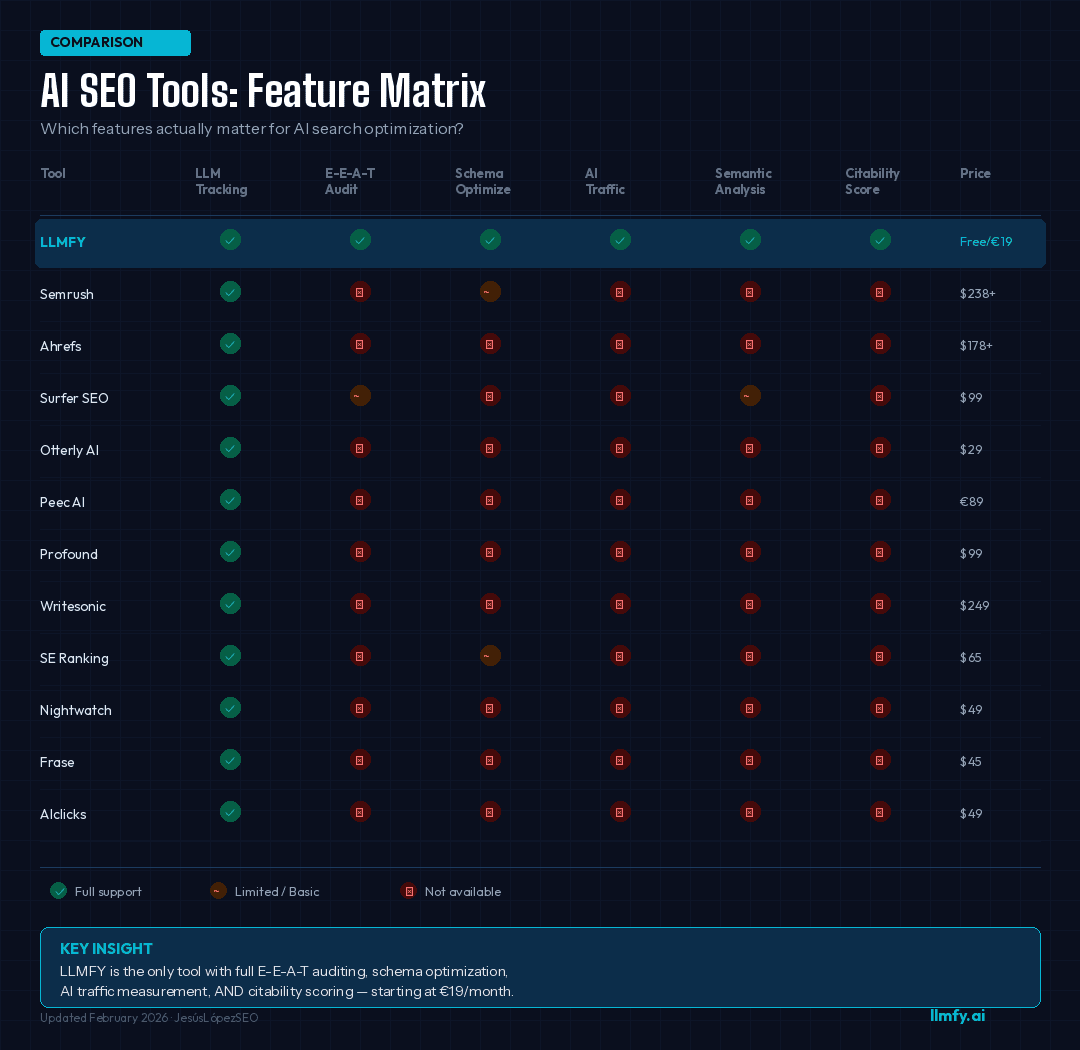
Comparison table: all 12 tools at a glance
| Tool | Best For | LLM Tracking | E-E-A-T Audit | Schema Optimization | AI Traffic | Starting Price |
|---|---|---|---|---|---|---|
| LLMFY | All-in-one LLMO | Yes (5 platforms) | Yes | Yes (9+ types) | Yes (GA4) | Free / €19/mo |
| Semrush | Connected SEO + AI visibility | Yes | No (Authority Score) | Site Audit validation | Yes (Enterprise AIO) | $99/mo add-on / $199/mo bundle |
| Ahrefs | Backlink + AI tracking | Yes (add-on) | No | No | No | $178+/mo |
| Surfer SEO | Content + AI visibility | Yes | Limited | No | No | $99/mo |
| Otterly AI | Budget AI monitoring | Yes | No | No | No | $29/mo |
| Peec AI | Competitive benchmarking | Yes | No | No | No | €89/mo |
| Profound | Enterprise LLM intel | Yes (10+ LLMs) | No | No | No | $99/mo |
| Writesonic | Content + GEO | Yes | No | No | No | $249/mo |
| SE Ranking | Full SEO + AI | Yes | No | Basic | No | $65/mo |
| Nightwatch | Rank tracking + AI | Yes | No | No | No | $49/mo |
| Frase | Content workflow + GEO | Yes | No | No | No | $45/mo |
| AIclicks | Monitoring + optimization | Yes | No | No | No | $49/mo |
How to actually choose (no fluff, just honest advice)
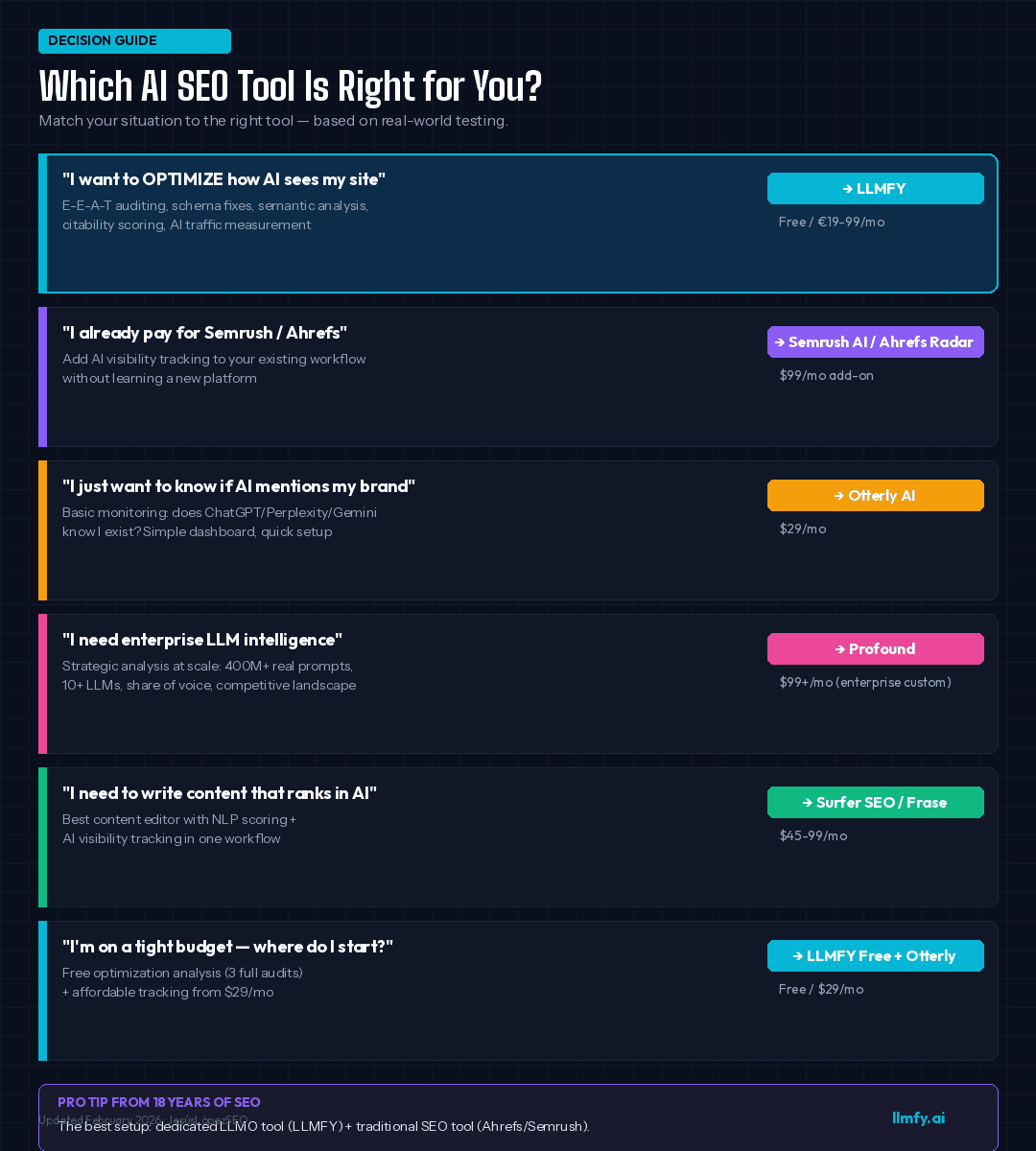
After living with all of these tools, here's my honest framework based on real scenarios I see with clients every week:
"I want to actually improve how AI sees my site, not just watch the dashboard." → LLMFY. It's the only tool on this list with E-E-A-T auditing, schema optimization, semantic analysis, citability scoring, AND AI traffic measurement. Starts at €19/month, free plan gives you 3 full analyses to decide if it's for you.
"I want AI visibility connected with my SEO, competitive research, and technical auditing." → Semrush. It tracks mentions, citations, sentiment, prompts, and competitors, then ties those findings to keyword, backlink, authority, and technical-crawl data. It's more platform than you need for basic monitoring, and the AI side leans tracking over optimization (no dedicated E-E-A-T or schema workflow), but it's the natural pick if your team works across both SEO and AI search. From $99/month as an add-on, or $199/month bundled as Semrush One.
"I just want to check if ChatGPT mentions my brand. That's it." → Otterly at $29/month. Simple, affordable, does exactly that. Nothing more, nothing less.
"We're a large enterprise and we need to understand LLM perception at scale." → Profound. Deep dataset, broad coverage, strategy-level insights. Budget accordingly.
"I need to write content that ranks in both Google and AI." → Surfer ($99/month) if you want the best content editor. Frase ($45/month) if budget matters more.
"I'm on a tight budget but I want to start somewhere." → LLMFY's free plan for optimization analysis. Otterly at $29/month for basic tracking. Frase at $45/month for content workflow. You don't need to spend $200+/month to start.
Here's what I'll leave you with: the AI search landscape is moving faster than any SEO shift I've seen in 18 years. The brands that figure out how LLMs perceive their content today will have compounding advantages for years to come. The specific tool you pick matters less than the decision to stop ignoring AI search and start optimizing for it.
Start Your Free AI Search Analysis
Frequently Asked Questions
What is an AI SEO tool?
An AI SEO tool helps you optimize your website for AI-powered search engines like ChatGPT, Perplexity, Google AI Mode, Claude, and Gemini. Unlike traditional SEO tools that focus on Google rankings and backlinks, AI SEO tools analyze how LLMs perceive your content, track your visibility in AI-generated answers, and provide recommendations to improve your chances of being cited.
What is the difference between traditional SEO tools and AI SEO tools?
Traditional SEO tools (Semrush, Ahrefs, Moz) focus on Google rankings, keyword research, backlinks, and technical audits. AI SEO tools focus on LLM visibility, E-E-A-T signals for AI, schema optimization for AI comprehension, citability scoring, and monitoring how your brand appears in conversational AI responses.
Do I still need traditional SEO tools if I use AI SEO tools?
Yes. Traditional SEO and AI search optimization are complementary. Your Google rankings still influence how AI models perceive your authority. The best approach is using a traditional SEO tool (Semrush, Ahrefs, SE Ranking) alongside a dedicated AI optimization tool (LLMFY) to cover both channels.
Which AI SEO tool is best for small businesses?
LLMFY offers the best value for small businesses with a free plan (3 analyses) and paid plans starting at €19/month. Otterly ($29/month) is the cheapest tracking-only option. Frase ($45/month) is good for content-focused small teams.
How much does AI SEO cost?
Dedicated AI SEO tools range from free to $500+/month. LLMFY starts at €19/month for full optimization features. Tracking-only tools like Otterly start at $29/month. Enterprise tools like Profound start at $99/month but scale to custom pricing. Adding AI features to existing tools like Semrush costs $99/month extra per domain.
What is LLMO?
LLMO stands for Large Language Model Optimization. It's the practice of optimizing your website and content to be discoverable, understood, and cited by AI search engines. LLMO includes optimizing E-E-A-T signals, implementing proper schema markup, improving semantic structure, and ensuring AI crawlers can access your content.
Can ChatGPT be used as an AI SEO tool?
ChatGPT is useful for SEO tasks like content brainstorming, keyword clustering, and technical troubleshooting, but it's not a dedicated AI SEO tool. It doesn't track your visibility, audit your E-E-A-T signals, analyze your schema, or measure AI traffic. Use it as a complement to specialized tools, not a replacement.
Sources
- LLMFY Platform — https://llmfy.ai
- Semrush AI Toolkit documentation — https://www.semrush.com/blog/best-ai-seo-tools/
- Ahrefs Brand Radar — https://ahrefs.com/brand-radar
- Surfer SEO AI features — https://surferseo.com/blog/best-ai-seo-tools/
- Otterly AI platform — https://otterly.ai
- Peec AI — https://peec.ai
- Profound AI — https://getprofound.ai
- SE Ranking AI tools review — https://seranking.com/blog/best-ai-seo-tools/
- Backlinko AI SEO tools analysis — https://backlinko.com/ai-seo-tools
- Princeton GEO Study — Aggarwal et al. (2023), "GEO: Generative Engine Optimization"
Updated: February 28, 2026. Pricing and features verified at time of publication. This article will be updated as tools evolve.