Striking Distance Keywords: How to Find and Win Them in the AI Search Era [2026]

Every month, when I sit down to build SEO roadmaps for our agency clients, the first thing I open isn't a keyword research tool. It's Google Search Console. Because after 18+ years doing SEO, I've learned that the cheapest traffic you'll ever win is the traffic you're almost getting.
That's what striking distance keywords are: queries where you already rank close to the top, but not close enough to get clicks. Google has already decided your page is relevant. You just haven't proven it's the best answer yet.
In this guide I'll show you the exact workflow we use across 40+ client accounts to find these keywords, a simple formula to prioritize them, and—this is where it gets interesting—how the definition of "striking distance" has fundamentally changed now that AI Overviews, ChatGPT, and Perplexity sit between your rankings and your traffic.
What Are Striking Distance Keywords?
Striking distance keywords are search queries where your site ranks just outside the positions that actually get clicked—typically positions 4 to 15. They're "within striking distance" of the top because a modest optimization (a better title, a missing subtopic, a few internal links) can move them into the top 3, where the majority of clicks happen.
You'll see different ranges depending on who you ask. Moz talks about the top of page 2. Some agencies stretch it to positions 11–30. After years of testing this across very different niches—insurance, e-commerce, legal, health—my position is clear: the 4–15 range is where effort translates into results most predictably.
Here's why the math is so brutal:
- Positions 1–3 capture roughly half of all organic clicks
- Position 8 gets around 3% CTR on a good day
- Page 2 gets crumbs
So moving a keyword from position 12 to position 4 isn't a linear improvement. It's often a 5x–10x traffic multiplier from content you already wrote, on a page Google already trusts. No new content. No new backlinks. Just finishing the job.
Why they beat new content almost every time
Most content teams have a bias: when traffic stalls, they create more articles. I see this constantly in audits. Meanwhile, they're sitting on 30–50 pages ranking at position 7 or 11 that nobody has touched since publication.
Think about what a striking distance keyword actually represents. Google has crawled your page, evaluated it against everything else on the web, and placed it above 95% of competing pages. All the hard, slow, expensive signals—indexation, relevance, baseline authority—are already there. What's missing is usually small and specific.
New content starts from zero. Striking distance optimization starts from position 9. That's the whole argument.
The Striking Distance Game Changed in 2026
Before I give you the workflow, we need to talk about the elephant in the SERP.
The classic playbook assumed a simple equation: better position = more clicks. That equation broke when AI Overviews started appearing on informational queries. Ahrefs research found that when an AI Overview is present, the top organic result loses roughly a third of its expected clicks. On some query types we've measured CTR collapses far worse than that in client GSC data—stable position 3 rankings whose clicks dropped 40–60% year over year, purely because an AI answer now sits on top.
This changes the striking distance calculation in two ways:
1. Position gains are worth less on AIO-heavy queries. Fighting your way from position 11 to position 4 on a query where an AI Overview answers everything above the fold may win you a fraction of the traffic you modeled.
2. There's a new striking distance target: the citation. Google assembles AI Overviews from a pool of sources that doesn't strictly follow the top 10. Pages ranking 5th, 8th, even 15th get cited constantly. If you rank in striking distance for a query that triggers an AI Overview, you're not just close to the top 3—you're close to being quoted as the answer itself. The same applies to ChatGPT and Perplexity, which lean heavily on search indexes to ground their responses.
This is the core of what I call "Same Factors, Different Weights": the signals that win rankings and the signals that win AI citations overlap heavily, but they're weighted differently. Clear extractable answers, entity clarity, freshness, and structured data punch far above their weight in AI selection.
So the modern definition I work with is this: a striking distance keyword is any query where you're close to winning either the click or the citation—and ideally both.
How to Find Striking Distance Keywords in Google Search Console (Step by Step)
Everything you need is free and sitting in your GSC account. Here's the exact process:
Step 1 — Open the Performance report. Search results → set the date range to the last 3 months. Shorter windows are noisy; longer windows hide recent movement.
Step 2 — Filter by position. Add a filter: Position greater than 3.9 and smaller than 15.1. This isolates your striking distance zone.
Step 3 — Exclude branded queries. Add a query filter excluding your brand name (or use the branded filter if your property supports it). Branded queries pollute everything—you'll rank for them anyway.
Step 4 — Sort by impressions, descending. Impressions are your demand signal. A keyword at position 9 with 4,000 impressions is a bigger prize than one with 60.
Step 5 — Export and score. Export to a spreadsheet and add one column:
Opportunity Score = Impressions × (Expected CTR at position 3 − Current CTR)
Use conservative benchmarks: ~10% expected CTR at position 3, ~6% at position 5, ~3% at position 8, ~1.5% at position 12. Sort descending. The top 10 rows are your quarter's roadmap.
The average position trap (almost everyone falls into this)
One warning from the trenches, because I've seen this mistake burn hours of optimization work: GSC shows average position, and averages lie.
A query showing "position 8" might actually be position 2 in Spain and position 28 in Mexico, averaged. Or position 3 for the query with one word order and position 19 for another variant. Before optimizing anything, click into the query, check the Pages and Countries tabs, and confirm which URL is actually ranking where. Sometimes your "striking distance keyword" is really a cannibalization problem: two of your own URLs splitting the signal. Fix the cannibalization first, and the position often jumps on its own.
Check the citation layer before you prioritize
Here's the step nobody else adds. For each of your top 10 opportunities, search the query and note three things:
- Does an AI Overview appear?
- If yes, is your page cited in it?
- Who is cited—and from what positions?
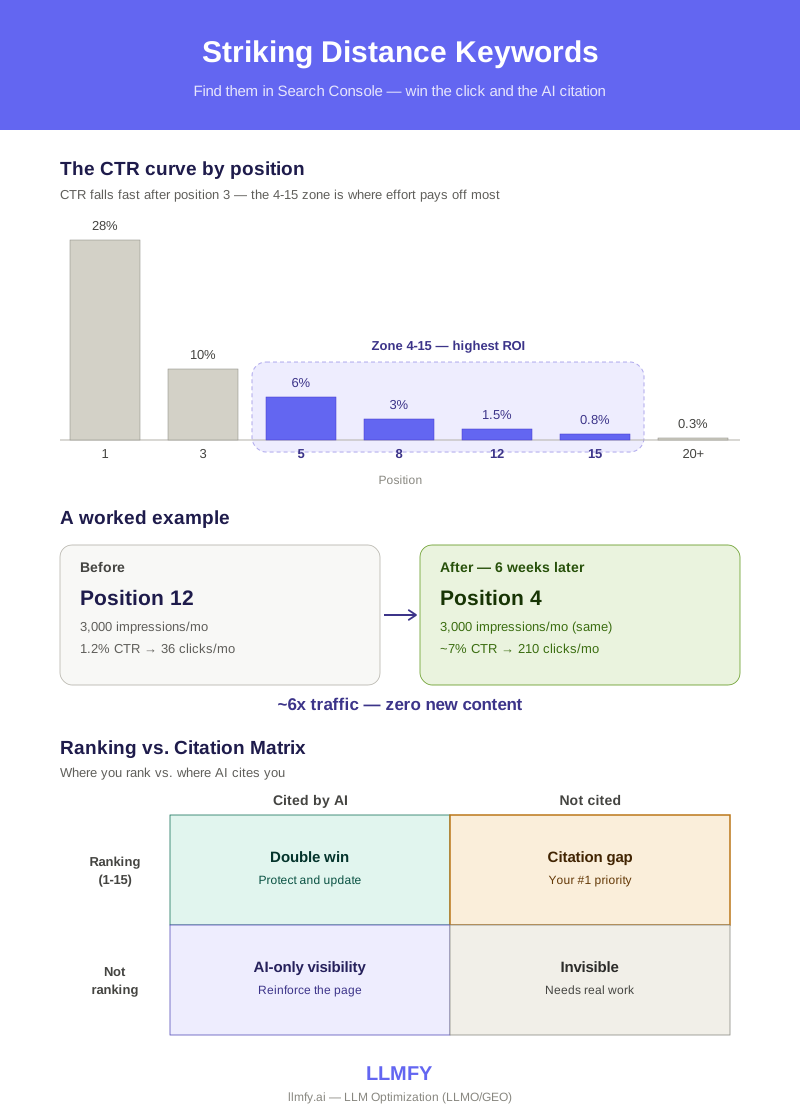
This maps every keyword into what we built into LLMFY as the Ranking vs. Citation Matrix:
| Cited by AI | Not cited | |
|---|---|---|
| Ranking (1–15) | Double win — protect and update | ⚡ Citation gap — your #1 priority |
| Not ranking | AI-only visibility — reinforce the page | Invisible — needs real work |
The top-right quadrant—ranking in striking distance but absent from the AI answer—is the modern quick win. You've already earned Google's trust; you just haven't packaged your content in a way AI systems can extract and quote.
📊 The Striking Distance Zone at a Glance
| Position | Approx. organic CTR |
|---|---|
| 1 | ~28% |
| 3 | ~10% |
| 5 | ~6% |
| 8 | ~3% |
| 12 | ~1.5% |
| 15 | ~0.8% |
| 20+ | ~0.3% |
🎯 The zone that matters: positions 4–15. Enough search demand to be worth the effort, and enough trust already earned from Google that a rewrite — not a rebuild — can flip the switch. Before — Position 12 · 3,000 impressions/mo · 1.2% CTR → 36 clicks/mo After (6 weeks later) — Position 4 · same 3,000 impressions/mo · ~7% CTR → 210 clicks/mo → ~6x traffic, zero new content
How to Optimize Striking Distance Keywords (The 2026 Playbook)
Once you have your prioritized list, here's what actually moves the needle, in order of impact:
1. Align the title tag and H1 with the real query
Still the single biggest lever. Pull up the page's Queries tab in GSC and look at the exact language people use. If your H1 says "Content Marketing Guide" and the striking distance query is "content marketing strategy template," you have a mismatch. Rewrite the title with the query language in the first 45 characters. I've watched this alone move pages 3–5 positions in two weeks.
2. Add an answer capsule under the relevant heading
Write a 40–60 word, self-contained, direct answer immediately below the H2 that matches the query. First sentence answers; second adds specificity; third scopes it. This serves three masters at once: featured snippets, AI Overview extraction, and readers who scan. It's the highest-ROI writing pattern for the citation gap quadrant.
3. Close the subtopic gaps
Compare your page against the current top 3. What sections do they have that you don't? You don't need 2,000 more words—you usually need one or two missing subtopics covered properly. Depth of coverage is what separates position 8 from position 3 far more often than word count.
4. Fire internal links at the page
Find your most authoritative pages (GSC → Links → Top linked pages) and add contextual links to your striking distance URL with descriptive anchors. In our experience this is the most underused lever in SEO—it costs nothing and regularly moves pages 2–3 positions on its own.
5. Update schema and freshness signals
Mark the page up properly—Article, Author, FAQ where it applies—and update the modified date with a real content update behind it. AI systems disproportionately favor fresh, well-structured sources when choosing what to cite. If you want the full implementation guide, we wrote one: Schema for LLMs. And since citation selection is ultimately a trust decision, your author and organization signals matter too—here's our deep dive on E-E-A-T for LLMs.
What NOT to do
- Don't de-optimize the head term. If the page targets a high-value primary keyword, don't sacrifice it to chase a secondary striking distance query. Check what the page is supposed to rank for first.
- Don't chase averaged ghosts. Verify the real position per country/URL before working (see the trap above).
- Don't judge results before 30 days. Typical timeline: title/CTR changes show in 1–3 weeks, content changes in 2–6 weeks, AI citation changes in 2–4 weeks for AI Overviews and Perplexity, longer for ChatGPT.
A Worked Example (So You Can See the Math)
Say you find a query with 3,000 monthly impressions at position 12, current CTR 1.2% → 36 clicks/month.
You align the title, add an answer capsule, cover two missing subtopics, and point four internal links at the page. Six weeks later it sits at position 4, CTR ~7% → 210 clicks/month. That's a ~6x gain from one afternoon of focused work.
Now multiply by ten keywords. That's why striking distance optimization is the first thing we check in every monthly roadmap—before we ever propose a new post.
How LLMFY Automates This
You can absolutely run this workflow manually—I did for years. But it's exactly the kind of repetitive, cross-referenced analysis machines do better:
- GSC integration pulls your striking distance queries and converts them into the prompts real users ask AI assistants
- The Ranking vs. Citation Matrix maps every keyword into the four quadrants automatically, so citation gaps surface instantly
- AIO cannibalization detection flags queries where an AI Overview is eating clicks from your stable rankings—before you waste effort optimizing for a click that no longer exists
→ Connect your Search Console to LLMFY free and get your striking distance + citation gap report in minutes.
Conclusion
Striking distance keywords remain the highest-ROI play in SEO—but the definition of "winning" has expanded. In 2026, being at position 8 means you're close to two prizes: the top 3 ranking and the AI citation. The sites that treat both as the target—clear answers, tight entity signals, complete schema, real expertise on display—are the ones showing up whether users search on Google or ask ChatGPT.
Stop creating. Start finishing. Your next traffic win is already ranking at position 9.
Frequently Asked Questions About Striking Distance Keywords
What are striking distance keywords?
Striking distance keywords are search queries where your site already ranks close to the top—typically positions 4 to 15—but not high enough to capture meaningful clicks. Because Google already considers the page relevant, small targeted optimizations can push it into the top 3, producing large traffic gains without creating new content.
What position range counts as striking distance?
Definitions vary from positions 4–15 to 11–30 depending on the source. Based on our agency data across dozens of accounts, positions 4–15 is the range where optimization effort produces the most predictable returns. Beyond position 20, pages usually need structural work or links, not quick wins.
How do I find striking distance keywords in Google Search Console?
Open the Performance report, set a 3-month date range, filter Position greater than 3.9 and smaller than 15.1, exclude branded queries, and sort by impressions. Then prioritize with an opportunity score: impressions multiplied by the gap between expected CTR at position 3 and your current CTR.
How long does it take to move a striking distance keyword to the top 3?
Title and CTR-focused changes typically show movement in 1–3 weeks. Content and internal linking changes take 2–6 weeks to be fully processed. Don't evaluate an optimization as failed before 30 days have passed.
Do striking distance keywords still matter with AI Overviews?
Yes—arguably more. AI Overviews cite sources from beyond the top 3, so ranking in positions 4–15 puts you within striking distance of being quoted as the AI answer itself. The modern approach optimizes for both the ranking and the citation: direct answer capsules, updated schema, and strong author signals.
Sources and References
- Google Search Central - Performance Report Documentation - Official GSC performance data reference.
- Ahrefs - AI Overviews Reduce Clicks - Research on AIO impact on organic CTR.
- Advanced Web Ranking - Google Organic CTR Study - CTR benchmarks by position.
- Moz - Finding Striking Distance Keywords - Classic methodology reference.
- SEOTesting - Striking Distance Keywords via GSC API - Programmatic extraction approach.