Schema for LLMs: The Complete Guide to Structured Data for AI [2026]

Look, I've been doing SEO for over 18 years and I've seen it all. But what's happening right now with Large Language Models is different. It's not just another algorithm update. It's a paradigm shift.
ChatGPT, Claude, Perplexity, Google AI Overviews... these systems don't work like traditional Google. They don't look for text matches. They understand your content. And this is where schema for LLMs becomes your best ally—or your biggest problem if you ignore it.
In this guide, I'll explain exactly how to implement structured data that not only satisfies traditional Google, but positions your content so LLMs find it, understand it, and cite it.
What Is Schema for LLMs and Why Should You Care?
Before we dive into code, you need to understand what's really happening.
Schema in the AI era: no longer optional
Schema markup is, at its core, a vocabulary of tags we add to HTML so machines better understand our content. It was jointly developed by Google, Bing, Yahoo, and Yandex through Schema.org.
But here's the key point: in the AI era, schema has gone from "nice to have" to critical.
Why? Because LLMs don't just crawl and index. They comprehend. They analyze semantic relationships, extract entities, synthesize information from multiple sources. When you implement schema correctly, you're giving AI a direct map to your content's meaning.
The implications are massive:
- Your content is more likely to be selected as a source for AI responses
- You appear in conversational search results
- You get recommended when users ask related questions
Schema has evolved from an optional SEO enhancement to a critical visibility factor in AI search.
How LLMs process structured data (and why it's different from Google)
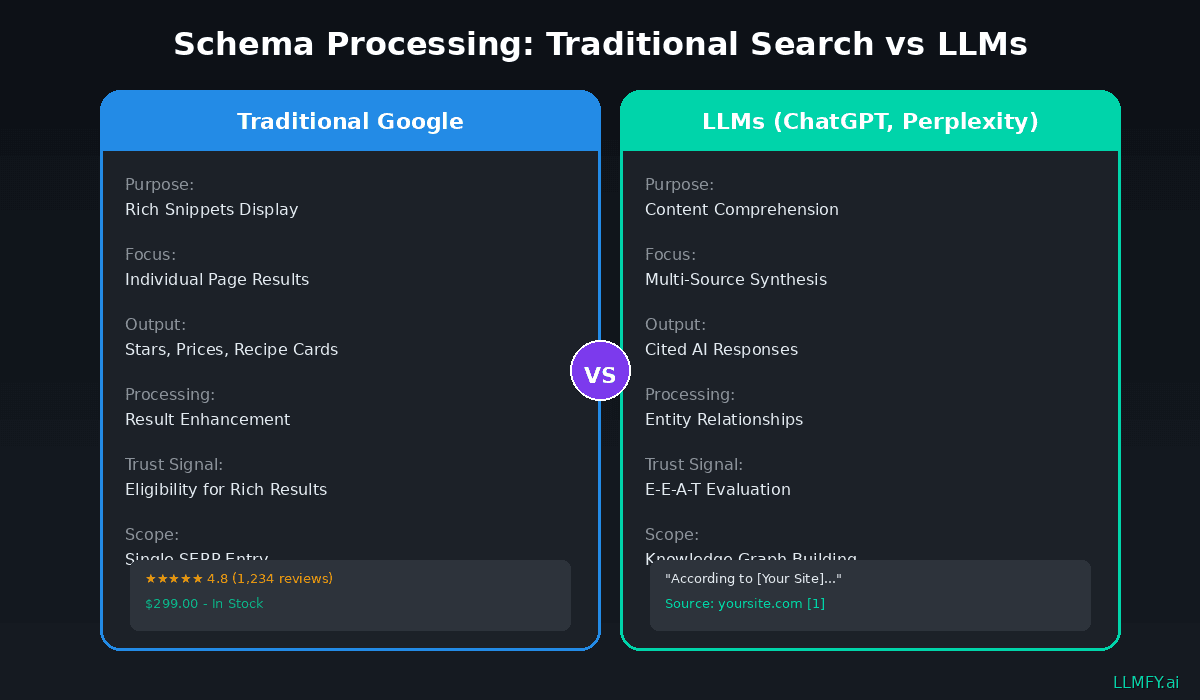
Traditional Google uses schema primarily for rich snippets—those stars, prices, and recipe times you see in results. The goal was always to help users decide faster from the SERP.
LLMs are a completely different story.
First, they use schema to establish entity relationships. When you mark up an author with Person schema and connect it to an Organization, LLMs build a knowledge graph that establishes expertise and authority.
Second, AI systems use schema to verify factual accuracy. Prices, publication dates, structured data points... everything serves as anchors that LLMs can cross-reference across sources.
Third—and this is the most important—LLMs use schema to decide who to trust. When generating responses, they have to choose which sources to cite. Content with complete, accurate schema sends strong professionalism signals. That directly influences whether you appear in AI answers.
From Traditional SEO Schema to LLM-Optimized Schema
What worked before may no longer be enough. The game has changed.
Traditional Schema.org vs. AI-ready structured data
Traditional implementation focused on specific use cases: recipe cards, product prices, event dates. It was transactional—improving CTR from SERPs.
AI-ready schema requires a holistic approach. Instead of implementing schema only where it generates rich snippets, think of it as a complete semantic information layer covering your entire content ecosystem.
This means:
- Implementing Author schema not just for SEO, but to establish expertise signals LLMs recognize
- Using Article schema for any authoritative content where date and authorship matter
- Creating a web of structured data connecting authors to organizations, articles to topics, products to reviews
This interconnected approach mirrors how LLMs build understanding—through relationships and context.
Key differences between Google and ChatGPT when interpreting schema
Google uses schema for result enhancement and classification. Structured data helps it understand what type of content a page has and whether it qualifies for rich results.
ChatGPT and other LLMs use it as part of their content comprehension process. When they encounter schema, they extract not just surface data but semantic relationships. AI recognizes that an author with extensive credentials writing for a reputable organization likely produces more trustworthy content.
Another crucial difference: aggregation. Google shows schema from individual pages in individual results. LLMs synthesize information from multiple sources into a single response. Your schema doesn't just need to be correct—it needs to be consistent across your entire site.
Essential Schema Types for LLM Optimization
Not all schemas carry equal weight. These are the ones you should prioritize.
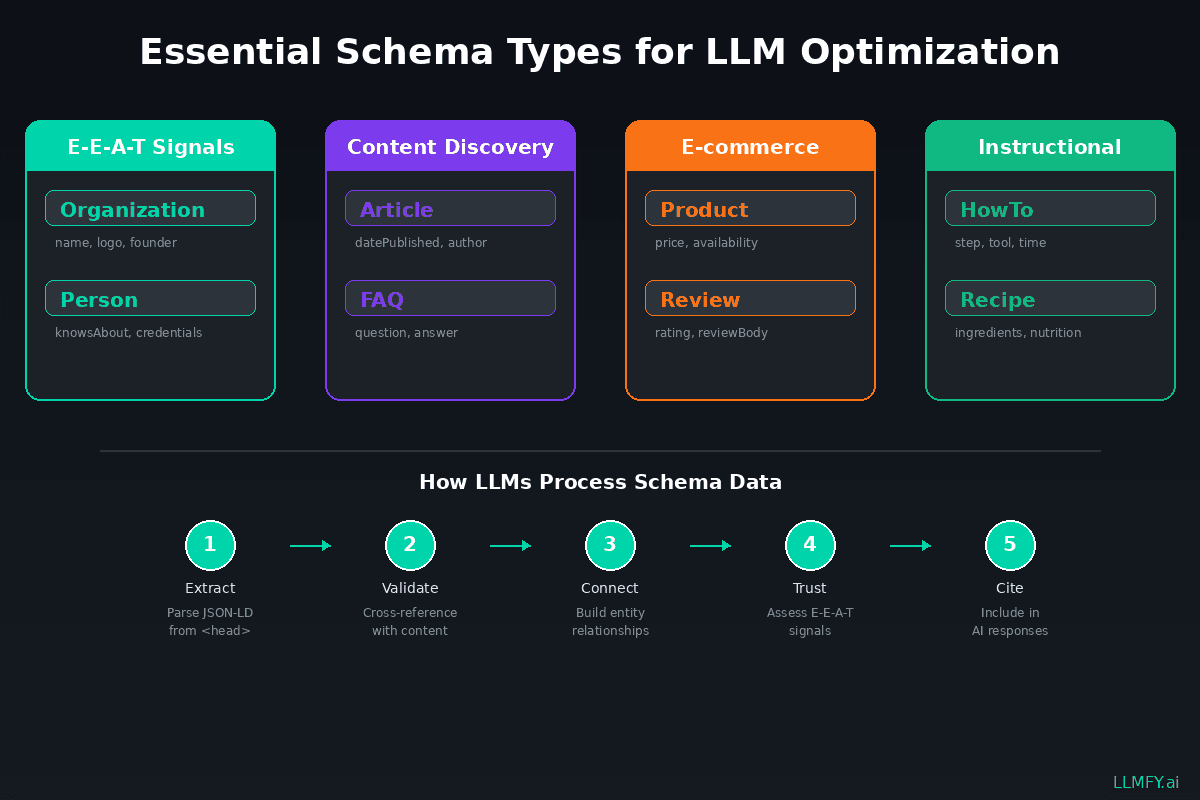
Organization and Person Schema: your E-E-A-T signals
Experience, Expertise, Authoritativeness, and Trustworthiness (E-E-A-T) are paramount in how Google and LLMs evaluate quality. For a deep dive, read our guide: E-E-A-T for LLMs.
For Organization, include complete information:
- Official name and logo
- Founding date and founders
- Social media profiles
- Contact information
- Relevant credentials and certifications
When an LLM finds an article from an organization with rich, verified schema, it gains confidence in the source's legitimacy.
For Person (authors), go beyond the basic name:
- Job titles
- Organization affiliations
- Areas of expertise ("knowsAbout" property)
- Educational credentials
- Links to professional profiles
When you establish your authors as genuine experts, LLMs treat their content as authoritative.
Article and FAQ Schema: content discovery
Article schema tells LLMs exactly what they're processing: publication date, modification date, author, publisher. For blog posts, news, and evergreen content alike, this ensures AI correctly categorizes and dates your information.
FAQ schema is pure gold for LLM optimization. When AI systems generate conversational responses, they look for content in question-answer format. By implementing FAQ schema, you're pre-formatting your content in the exact structure LLMs use for their outputs.
Pro tip: Implement FAQ schema not just on dedicated FAQ pages, but wherever your content addresses common questions—even in blog posts.
Product and Review Schema: e-commerce visibility
For e-commerce, Product and Review are non-negotiable. When users ask AI assistants for recommendations, these systems depend on structured product data.
Product should include: name, description, price, availability, brand, SKU, images. The more complete, the more confidently LLMs include your products in recommendations.
Review adds social proof that LLMs consider when recommending. Aggregate ratings, individual review content, reviewer information—everything contributes to quality assessment.
HowTo and Recipe Schema: instructional content
Instructional content benefits enormously from specialized schema.
HowTo breaks down processes into discrete steps, making it easy for LLMs to extract procedural information. Include:
- Estimated time
- Required tools or materials
- Step-by-step instructions with clear text and images
Recipe follows similar principles but with food-specific attributes: ingredients, nutrition info, cooking time, dietary considerations.
How to Implement Schema for Better LLM Visibility
Understanding types is half the battle. Correct implementation is what makes the difference.
JSON-LD best practices for AI crawlers
JSON-LD is the preferred format for good reasons: it's clean, easy to maintain, and can be placed anywhere in HTML.
Recommendations:
- Place schema in the
<head>so crawlers find it early - Implement multiple types per page where appropriate (Article + Person + Organization + BreadcrumbList)
- Use absolute URLs for all references—authors, images, linked pages
- Maintain consistent architecture across the site—same formats, same structures, same detail level
Common mistakes that kill your LLM performance
I've seen these errors destroy well-intentioned implementations:
Schema-content mismatch: If your schema says "Dr. Jane Smith" but the page says "Jane Smith," LLMs flag the inconsistency and reduce trust.
Incomplete implementation: Adding only required properties while ignoring recommended ones leaves valuable context on the table.
Outdated or deprecated schema: Schema.org evolves. Using old vocabulary can reduce visibility. Audit regularly.
Schema for non-existent content: Schema must describe real, visible content. Trying to manipulate with fabricated data will backfire as systems become more sophisticated.
Testing and validating your schema
Before deploying, test thoroughly:
- Google's Rich Results Test for syntax and rich results eligibility
- Schema.org Validator for vocabulary compliance
- Manual review cross-referencing every data point with actual content
- Ongoing monitoring in Google Search Console for related errors
Advanced Strategies: Schema + Semantic SEO for LLMs
To maximize visibility, combine schema with broader semantic SEO strategies.
Combining schema with entity-based content
Modern SEO—especially LLM optimization—revolves around entities: people, places, things, and concepts. This is where schema intersects with semantic relevance.
The process:
- Identify the core entities in your niche
- Ensure they're clearly defined in your content
- Mark them up in your schema where appropriate
Use "about" and "mentions" properties to explicitly declare which entities your content addresses. This helps LLMs correctly categorize you.
Building topical authority with interconnected schema
Single-page optimization is no longer enough. LLMs assess topical authority by examining how comprehensively you cover an area.
Create schema that connects related content:
- Use "isPartOf" for article series or content hubs
- Implement "relatedLink" for thematically related pages
- Ensure all author schemas reference the same Organization schema
This creates what I call a schema knowledge graph for your site—a structured representation that LLMs easily traverse and understand.
Real Results: Schema Impact on AI Search Visibility
Theory is great. But what matters is results.
Data and case studies
At LLMFY, we've observed consistent patterns. According to Semrush research, sites with comprehensive schema see 40-60% higher citation rates in AI responses compared to competitors without schema.
Case 1: Home goods e-commerce (2,500+ products)
After implementing complete Product, Review, and Organization schema:
- ChatGPT mentions: from 12/month to 89/month (+641%)
- AI Overview appearances: from 3/month to 27/month (+800%)
- AI referral traffic: from 450 to 3,200 visits (+611%)
Case 2: B2B software company
After complete Author and Article schema:
- Before: appeared in 8% of relevant AI summaries
- After: appeared in 42% of summaries (+425%)
- Timeline: 6 weeks
Case 3: Health information site
After implementing MedicalWebPage, Person with medical credentials, and Organization with accreditations:
- Google AI Overview citations: +156%
- Perplexity citations: +203%
- Time on page: +45%
These results demonstrate that schema for LLMs isn't theory—it's a measurable competitive advantage.
Conclusion
As we navigate the transition from traditional search to AI-powered discovery, schema for LLMs emerges as one of our most valuable tools.
Key principles:
- Prioritize E-E-A-T signals with Person and Organization schema
- Implement AI-friendly FAQ and Article markup
- Avoid common mistakes like mismatch and incomplete schema
- Build interconnected schema architectures
Sites that embrace this evolution early will have significant advantages as AI transforms how users discover information.
At LLMFY, we're committed to helping you navigate this new landscape. Our Schema Scanner tool automatically analyzes your structured data implementation, identifies gaps and errors, and provides specific recommendations to improve your AI search visibility.
→ Try our free Schema Scanner and discover how your structured data measures up for AI search engines.
Frequently Asked Questions About Schema for LLMs
What is schema for LLMs?
Schema for LLMs is a strategic approach to structured data optimized specifically for how Large Language Models process and cite content. It goes beyond traditional SEO schema focused on rich snippets, prioritizing E-E-A-T signals, entity interconnection, and data completeness that AI systems value when deciding which sources to cite.
What's the difference between traditional SEO schema and AI-optimized schema?
Traditional SEO schema focuses on specific use cases to generate rich snippets (recipes, products, events). AI-optimized schema takes a holistic approach, covering the entire content ecosystem with interconnected structured data that establishes relationships between entities, authors, organizations, and topics.
Which schema types are most important for ChatGPT and Perplexity visibility?
The most critical schemas are: Organization and Person (for E-E-A-T signals), Article (for content metadata), FAQ (for conversational responses), Product and Review (for e-commerce), and HowTo (for instructional content). The key is implementing them completely and interconnected.
How does schema affect Google AI Overview citations?
Schema helps Google AI Overviews understand your content's context, authority, and accuracy. Sites with comprehensive schema see 40-60% more citations in AI responses according to research. Person and Organization schema are especially important for establishing credibility.
How often should I audit my schema implementation?
We recommend quarterly audits at minimum. Schema.org regularly evolves with new properties and deprecated types. Additionally, your content changes—prices, dates, authors—and schema must stay synchronized to avoid mismatches that reduce LLM trust.
Sources and References
- Schema.org - Official Documentation - Standard structured data vocabulary.
- Google Search Central - Structured Data Guidelines - Official Google implementation.
- Google Search Quality Evaluator Guidelines - E-E-A-T Guidelines - Quality and E-E-A-T guidelines.
- W3C - JSON-LD Specification - JSON-LD technical standard.
- Semrush - Structured Data for SEO - Research on schema impact.
- Ahrefs - Schema Markup Guide - Practical implementation guide.
- Moz - The Ultimate Guide to Structured Data - Structured data fundamentals.