Google AI Overviews Are Eating Your Organic Traffic — Here's What the Data Says and How to Fight Back [2026]

I've spent over 18 years in the SEO industry. I've seen every major shift — Panda, Penguin, mobile-first indexing, Core Web Vitals. You name it, I've had clients panicking about it at some point. But nothing — and I mean nothing — compares to the confusion I'm seeing right now around AI search.
Here's what bugs me. The entire industry seems to be staring at the wrong screen.
Conferences are packed with talks about "ranking in ChatGPT." Agencies that were doing basic on-page SEO six months ago are now billing themselves as "GEO experts." There's an absolute gold rush happening, and most of it is chasing a market that — and I say this as someone who literally built a platform for AI search optimization — barely exists yet.
The real battle for your organic traffic? It's not ChatGPT. It's not Perplexity. It's not Claude. It's happening inside Google itself, through AI Overviews. And the data backs this up in a way that's hard to argue with.
Let me walk you through what I've found.
Here's the Number That Should Make You Pause: 3.2%
Rand Fishkin dropped a bombshell in early March 2026. Working with Datos (now a Semrush company), SparkToro analyzed desktop search behavior across 41 major websites throughout all of 2025. Millions of devices. US and EU/UK. The most comprehensive look at where people actually search that I've ever seen.
And the punchline? All non-Google AI tools combined — ChatGPT, Claude, Deepseek, CoPilot, Gemini, the whole gang — account for just 3.2% of desktop search activity.
I'll let that sink in for a second.
Google alone? 73.7% of all desktop searches. Traditional search engines altogether? Roughly 80%. Commerce sites like Amazon and Walmart? About 10%. Social networks? 5.5%. And then at the bottom, almost like an afterthought... AI tools at 3.2%.
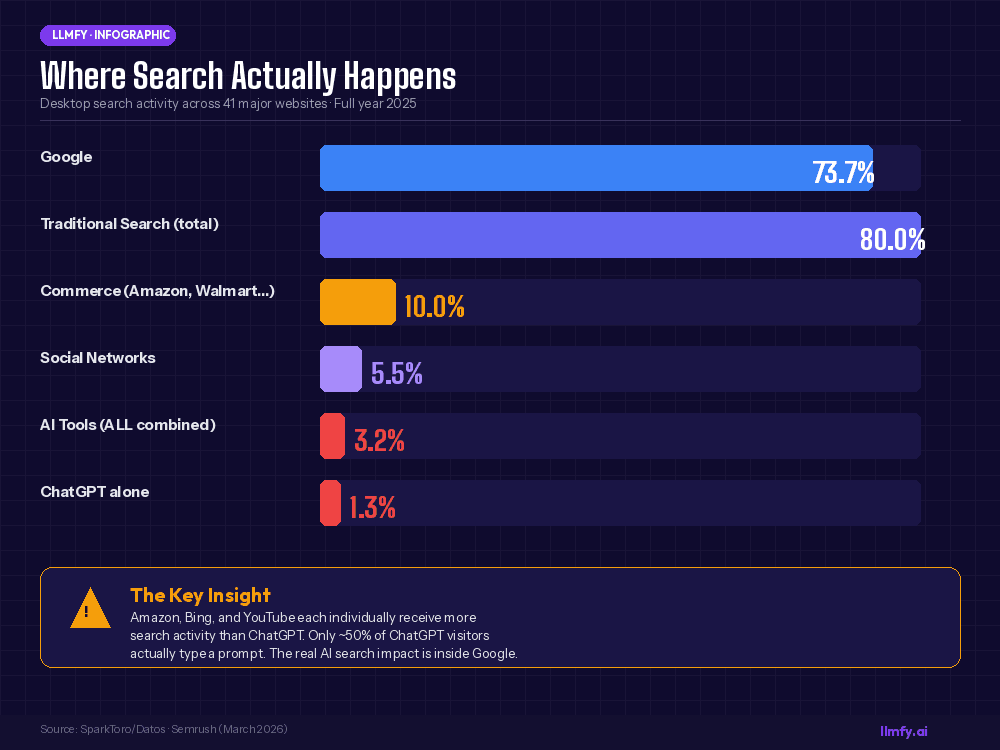
Now, it gets even more interesting when you dig into the details. SparkToro found that only about half the people who visit ChatGPT actually type a prompt. A lot of them are just clicking on shared chat links. So even that 3.2% is somewhat inflated.
Here's what really got me: Amazon, Bing, and YouTube each individually receive more search activity than ChatGPT. Individually. Yet I don't see anyone rushing to build "YouTube Search Optimization" agencies. The hype around ranking in ChatGPT is wildly disproportionate to the actual search volume happening there.
And SimilarWeb's own traffic data, shared by Lily Ray, paints an even more vivid picture. Google receives approximately 75 billion web visits per month worldwide. ChatGPT? About 5.5 billion. That's a 14× gap. And when you toggle on every LLM — Gemini, Claude, Perplexity, Grok, DeepSeek, Copilot — they're all flat lines at the bottom of the chart. Even Gemini, which has grown roughly 800% since September 2024 to about 2 billion visits, is still dwarfed by Google's volume.
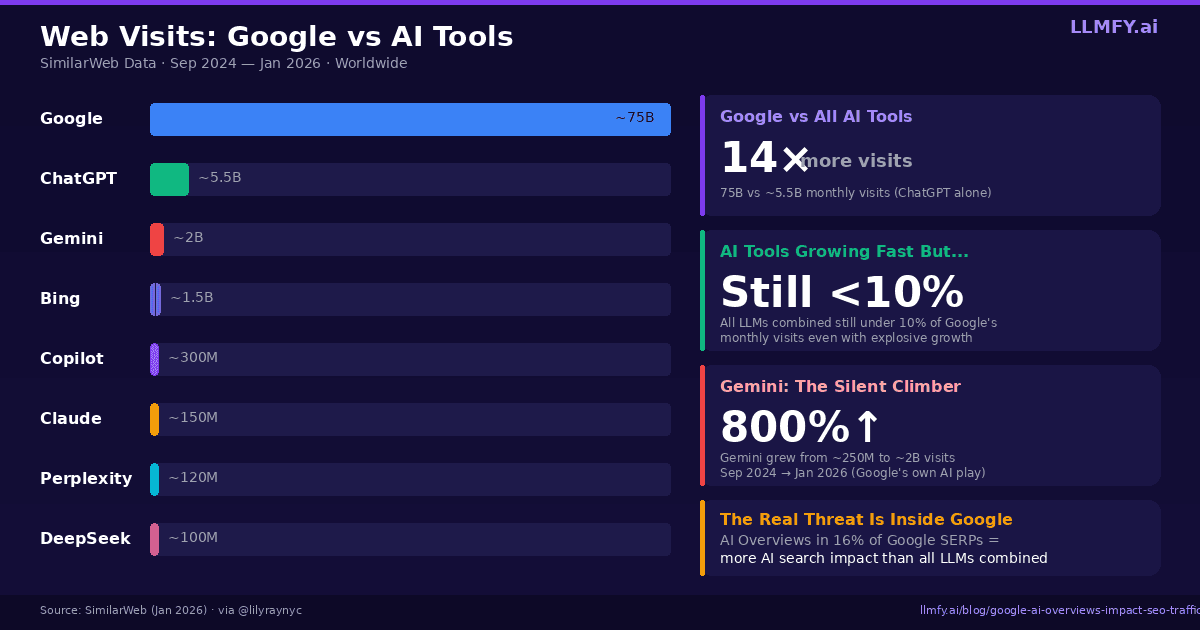
The visual is almost comical. When you show Google and all LLMs on the same chart, the AI tools are essentially a rounding error at the bottom of the graph. This isn't speculation — it's SimilarWeb tracking actual web visits across the entire internet.
Don't get me wrong — I'm not saying AI search doesn't matter. I built LLMFY specifically because I believe it does. But I think we need to be honest about where the impact is actually being felt right now.
Source: SparkToro — New Research: Search Happens Everywhere
So Where's Your Traffic Actually Going? Look Inside Google.
If external AI chatbots only represent 3.2% of search, then what's causing the traffic drops that every SEO is complaining about in 2025 and 2026?
The answer has been staring us in the face: Google AI Overviews.
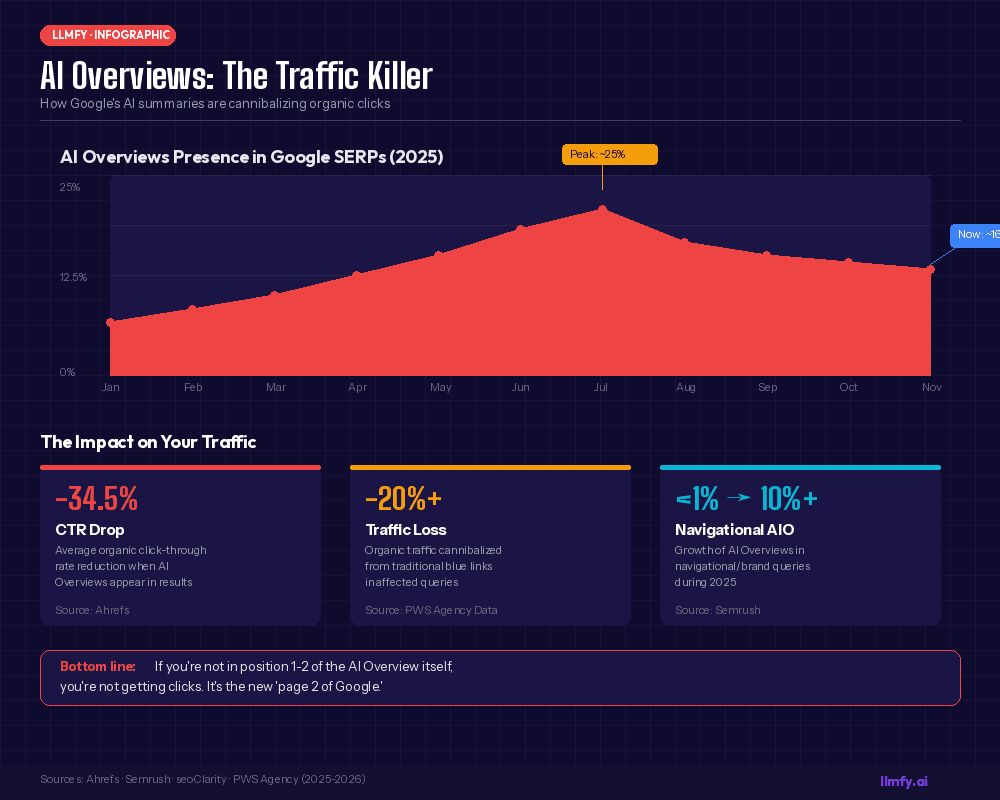
Semrush ran an analysis of over 10 million keywords and found that AI Overviews showed up in about 16% of search results by November 2025. There was a peak of nearly 25% in July before Google pulled back a bit — probably based on user data and engagement metrics, knowing how Google iterates.
Now, 16% might not sound like a lot. But do the math. That 16% sits on top of Google, which handles 73.7% of all searches. The sheer volume of searches influenced by AI Overviews dwarfs every external AI platform combined. We're talking orders of magnitude here, not small differences.
I've Seen This with My Own Clients
At my agency, Posicionamiento Web Systems, we manage SEO for clients across multiple industries in Spain. We've been tracking this obsessively since AI Overviews started rolling out, and the numbers are... uncomfortable.
Google AI Overviews are cannibalizing at least 20% of organic traffic from traditional blue links for our clients. Some sectors are hit harder than others — informational content in health, finance, and technology has taken the biggest beating. But even in niche B2B verticals, we're seeing meaningful erosion.
And the pattern I keep seeing is brutally simple: if you're not in position 1 or 2 within the AI Overview itself, you're not getting clicks. It's like the old "page 2 of Google" joke, except now it applies within a single SERP feature.
One client of ours — a specialized insurance comparison site — lost roughly 25% of their informational traffic between Q2 and Q4 of 2025. When we dug into the data, the pages losing traffic were almost exclusively ones where Google had started showing AI Overviews. The commercial and transactional pages? Mostly fine. But the top-of-funnel content that was feeding their conversion pipeline? Getting eaten alive.
It's Not Just Informational Queries Anymore
Early in 2025, AI Overviews were basically limited to informational searches — the "what is" and "how to" stuff. I assumed it would stay that way for a while. I was wrong.
Semrush found that navigational queries with AI Overviews grew from under 1% in January to more than 10% by November 2025. Google is pushing AI into brand searches, product comparisons, and even some transactional queries. They're essentially testing how far they can take this before users push back.
That's the part that worries me most. Because it means even your branded traffic — people searching for your company by name — could eventually get intercepted by an AI summary that may or may not send them to your site.
Sources: Semrush AI Overviews Study · Search Engine Land
The Plot Twist: The AI Platforms Say It's Just... SEO
OK so here's where it gets almost comical. While the SEO industry is tearing itself apart debating whether AEO, GEO, or LLMO requires entirely new strategies, the people who actually build these AI search systems keep saying the same thing over and over.
Glenn Gabe — who's been one of the sharpest voices on algorithm updates for years — recently compiled what he calls the "Gabeback Machine" for AI search. It's a collection of direct quotes from the major players, and honestly, the consistency of the message is striking.
Jeff Dean Himself Weighs In
Jeff Dean. Google's Chief AI Scientist at DeepMind. The guy has been at Google since 1999 and is genuinely one of the most important figures in modern AI. On the Latent Space podcast, he was asked how LLM search works versus traditional search.
His answer? It's not that dissimilar. You start with a huge pool of documents, whittle them down using increasingly sophisticated signals, and end up with what you show the user. Whether you're building a traditional search engine or an LLM-based system, the fundamental retrieval and ranking logic is remarkably similar.
When Jeff Dean says the systems aren't that different, I tend to listen.
Danny Sullivan Won't Let It Go (And He's Right)
Google's Danny Sullivan has been borderline evangelical about this. At WordCamp, he said — and I'm going to paraphrase because I love how blunt he was — that good SEO is good GEO, or AEO, or AI SEO, or LLM SEO, or LMNOPEO. What you've been doing for search engines is still perfectly fine.
He also specifically called out the advice to "chunk" your content — breaking everything into tiny bite-sized pieces because supposedly LLMs prefer that. Danny said he talked to Google's search engineers about it and their response was basically: please don't do that.
And honestly? This tracks with what I've always told my clients. Writing well-structured content with clear headings, logical flow, and digestible paragraphs is not the same thing as artificially fragmenting your text into weird little blocks. The first is good writing. The second is over-optimization. There's a massive difference.
Gary Illyes Keeps It Simple
At Search Central Live, Gary said to just use normal SEO practices for AI Overviews. You don't need GEO. You don't need LLMO. You don't need anything new.
Nick Fox Goes Even Further
Google's SVP of Knowledge and Information, Nick Fox, said on the AI Inside podcast that optimizing for Google's AI experiences is "the same" as optimizing for traditional search. His literal words were: build a great site, build great content.
Microsoft Agrees (With Some Useful Specifics)
Krishna Madhavan, Principal Product Manager at Bing, added some practical detail. Be skeptical of shortcuts, he said. The fundamentals of SEO are still critical — structure, freshness signals, crawlability, metadata, internal linking, backlinks. All the classics.
Even Perplexity Chimes In
Jesse Dwyer, Perplexity's head of communications, positioned things slightly differently — he said optimization for AEO sits somewhere in the middle of the debate. But he also stressed something I've been saying for a while: building a real brand matters enormously.
I completely agree with him on this. The brands I see performing best in AI citations are the ones that were already strong, already trusted, already creating original content. There's no shortcut to that.
Source: Glenn Gabe / GSQi — Straight From the (AI) Source: Is AEO/GEO Different Than SEO?
The RAG Factor: Why Your Google Ranking Matters for AI Search
What Nobody Is Saying: Same Factors, Different Weights
OK so everyone I just quoted is right. AI search visibility is built on SEO. I agree with that completely. But here's the nuance that I think both camps are missing — and I say this as someone who's spent the last year analyzing data and running tests across every major AI platform.
The traditional SEO factors still matter. But each AI platform weighs them differently.
This is the part that neither the "GEO is a revolution" crowd nor the "just do normal SEO" crowd is talking about. And it's the most important practical insight I can give you.
Let me explain what I mean with specific examples from what I've observed:
E-E-A-T signals have always been a factor in Google's traditional algorithm. But in AI responses — both AI Overviews and external LLMs — their weight is significantly higher. An AI system deciding whether to cite your content or a competitor's will lean much more heavily on author credentials, organizational authority, and demonstrable expertise than Google's blue links algorithm does. I've seen pages with mediocre backlink profiles but strong E-E-A-T signals consistently outperform higher-authority domains in AI citations.
Semantic depth is another classic SEO factor that gets amplified in AI search. Traditional Google can rank a well-optimized 800-word page for a competitive term if it has strong backlinks. An LLM deciding what to cite? It gravitates toward content that covers the topic comprehensively, uses related entities naturally, and demonstrates genuine understanding of the subject. Surface-level content that ranked through link authority alone is getting passed over.
Answering search intent in the first paragraphs is something every SEO knows matters. But for Google AI Overviews specifically, it's not just important — it's make-or-break. AI Overviews extract content to display directly in the SERP, and they strongly favor pages that put the direct answer near the top rather than burying it below lengthy introductions. This is a factor we measure in LLMFY's LLMO score, and when it's low, we flag it as a Quick Win because the fix is straightforward and the impact is immediate.
Schema markup is a nice-to-have in traditional SEO — it can get you rich snippets but it's not a major ranking factor. In AI search, it becomes significantly more important because structured data helps AI systems understand and extract your content with much higher confidence. Microsoft said this explicitly, and our data backs it up.
And here's what makes it even more complex: different platforms weigh these factors differently from each other. ChatGPT's citation behavior is not the same as Google AI Overviews, which is not the same as Perplexity, which is not the same as Claude. Each platform has its own retrieval mechanism, its own ranking preferences, its own content extraction logic.
What I've observed across hundreds of tests:
Google AI Overviews heavily prioritizes content structure, direct answers near the top, and existing search rankings (since it pulls from its own index). E-E-A-T matters but position in traditional search is the strongest predictor.
ChatGPT casts a wider net — it cites pages ranking in position 21+ about 90% of the time, as Semrush found. It cares less about your traditional ranking and more about topical authority, semantic completeness, and whether your content directly answers the specific question asked.
Perplexity tends to favor recent, well-sourced content with verifiable data points. It values citations and references within your own content — essentially, content that behaves like a research paper performs better.
This is exactly why I built LLMFY the way I did. Every feature maps to a specific SEO factor that has amplified importance in AI search. The E-E-A-T audit focuses on trust signals because they're weighted higher. The Semantic Analysis checks depth because LLMs reward it more. The LLMO score measures things like answer placement in the first paragraphs because AI Overviews specifically need that. The Prompt Tracker monitors each platform separately because each one behaves differently.
We're not inventing new SEO. We're measuring which parts of existing SEO matter most for each AI platform — and showing you exactly where the quick wins are. That's the gap nobody else is filling.
There's a technical concept that ties everything together, and I think a lot of people in the industry are missing it — or at least not emphasizing it enough.
It's called RAG — Retrieval Augmented Generation. And it's the reason why your traditional search ranking directly feeds into your AI search visibility.
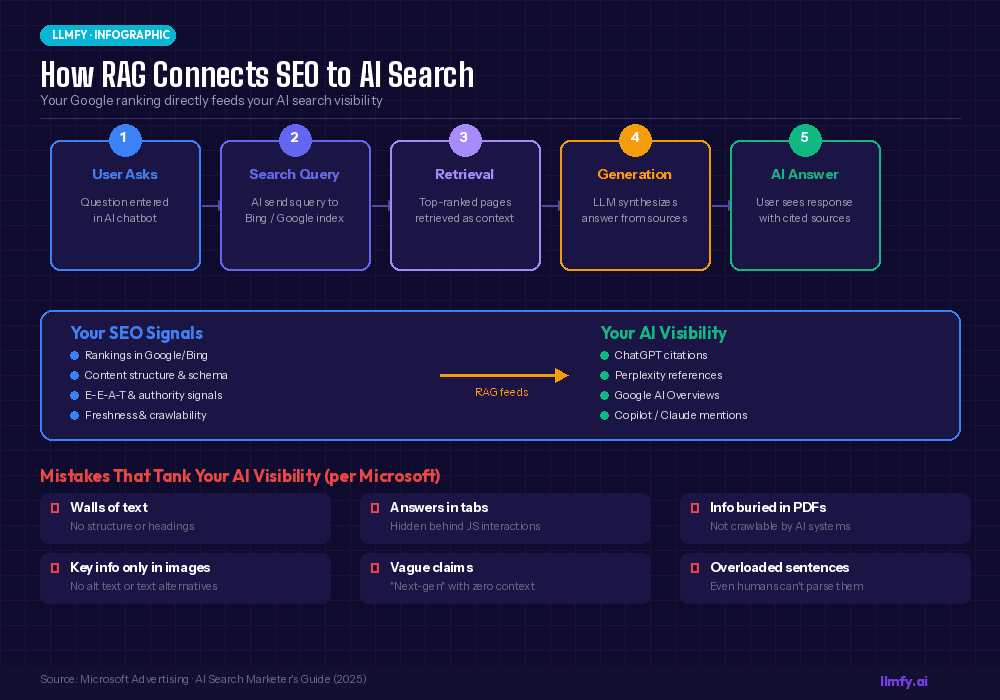
Here's how it works in plain English: when an AI system like ChatGPT, Copilot, or Perplexity needs to answer a question with current information, it doesn't just pull from its training data. It runs a real-time search — typically through Bing or Google — retrieves relevant pages, and then synthesizes an answer from those results.
Microsoft's marketer guide to AI search spells this out explicitly. The search index plays a critical role in grounding AI answers. Your site needs to rank well in traditional search to even be considered as a source for AI responses.
This is why I get frustrated when I see people treating AI search optimization as something completely separate from SEO. The systems are literally connected. RAG means that your Google ranking influences your ChatGPT visibility. Your Bing presence feeds into Copilot's answers. It's not two separate worlds — it's one pipeline.
OK, So What Should You Actually Do?
Let me boil all of this down into what I'd tell a client who sat across from me today.
Priority One: Worry About Google AI Overviews First
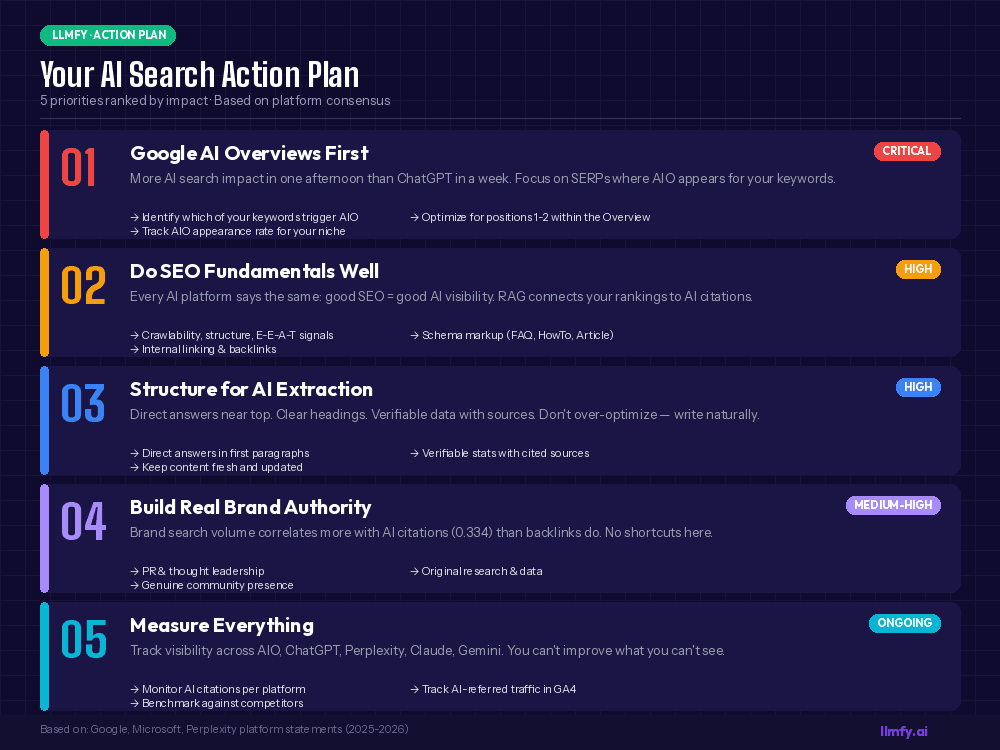
I know ChatGPT gets all the headlines. I know your CEO saw a LinkedIn post about "ranking in AI chatbots" and now wants a strategy for it. But the math doesn't lie. Google AI Overviews impacts more searches in a single afternoon than ChatGPT handles in a week. Start there.
Priority Two: Do SEO Well (Seriously)
I know this sounds anticlimactic. Everyone wants to hear about some revolutionary new tactic. But every single person I quoted above — from Jeff Dean to Gary Illyes to Krishna Madhavan — is saying the same thing: the foundation is traditional SEO done well.
Crawlability. Content structure. E-E-A-T signals. Schema markup. Internal linking. Backlinks. If you've been neglecting any of these, fix them before you start worrying about AI-specific optimization.
Priority Three: Structure Content for AI Extraction (Without Overthinking It)
Put direct answers near the top of relevant sections. Use a clear heading hierarchy. Add schema markup where it makes sense. Include verifiable data with sources. Keep things updated.
But — and I can't stress this enough — don't turn your content into some weird, over-optimized frankenstein just because you think AI likes it that way. Danny Sullivan literally consulted with Google's engineers about this, and they said they don't want people doing that. Write naturally. Structure logically. That's it.
Priority Four: Build Your Brand (For Real)
The data is clear: brand search volume has a stronger correlation with AI citations (0.334) than backlinks do. Sites cited across four or more AI platforms are 2.8 times more likely to be mentioned consistently by ChatGPT.
If you want AI systems to recommend you, you need to be a brand that people actually know and trust. PR, thought leadership, original research, genuine community contributions. The boring stuff. The real stuff.
Priority Five: Measure What Matters
You can't improve what you can't see. Track your visibility across Google AI Overviews, ChatGPT, Perplexity, Claude, and Gemini.
This is actually the reason I built LLMFY in the first place — because when I went looking for tools to do this for my agency clients, nothing existed that covered it properly.
How LLMFY Fits Into All of This
Look, I'm obviously biased here since I built the thing. But every feature in LLMFY maps directly to what the AI platforms themselves say matters — and what I've seen actually work with my agency clients over the past year:
E-E-A-T Audit — Analyzes the trust and authority signals that both Google AI Overviews and external LLMs evaluate when picking sources to cite.
Schema Scanner — Detects gaps in your structured data and tells you exactly what to fix. Microsoft literally recommends schema as a best practice for AI search visibility.
Semantic Analysis — Compares your content's semantic depth against competitors.
LLM Citability Score — A proprietary metric that tells you how likely your content is to be cited by AI systems.
Prompt Tracker — Monitors your visibility across Google AI Overviews, ChatGPT, Perplexity, Claude, and Gemini at the same time.
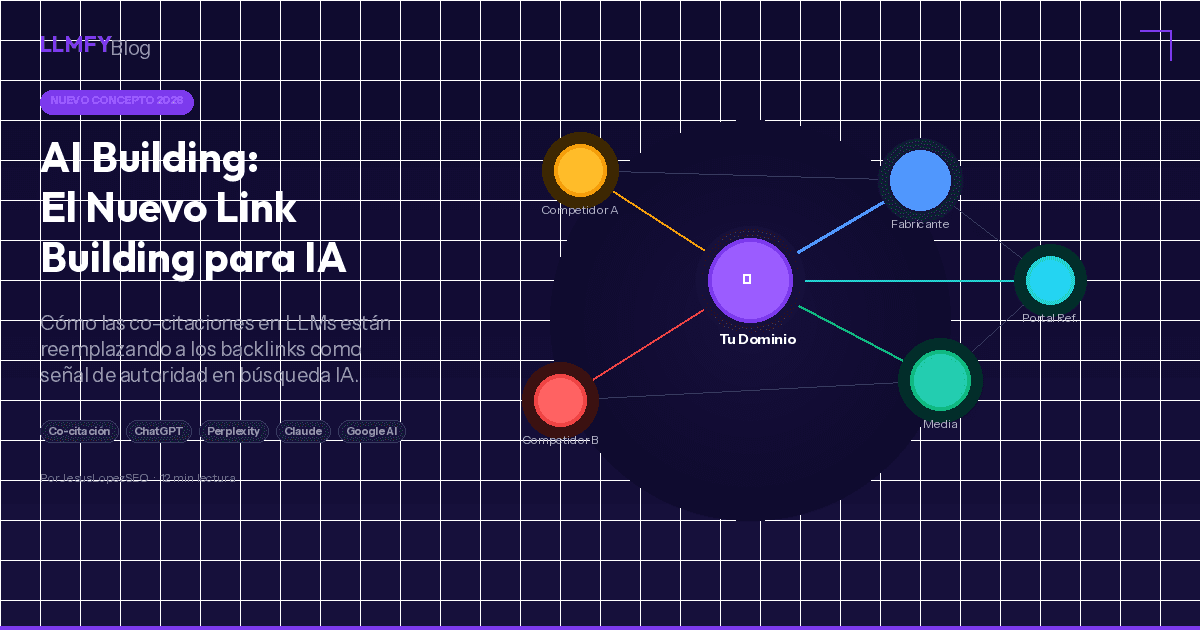
AI Building — Analyzes your co-citation neighborhood. Which domains does AI mention alongside yours?
IndexNow Integration — Pings search engines the moment your content changes.
Start your free AI visibility analysis →
What I Want You to Take Away From All This
The numbers: All non-Google AI tools combined are 3.2% of desktop search. Google is 73.7%. AI Overviews appear in ~16% of Google results, making them the biggest AI search surface by a massive margin. And they're already costing sites 20-35% of their organic clicks when they appear.
The expert consensus: Google, Microsoft, and Perplexity all agree — AI search visibility starts with strong SEO. It's not a separate discipline. The acronyms are new; the work isn't.
The action plan: Focus on AI Overviews first. Do SEO fundamentals well. Structure content clearly. Build real brand authority. Monitor everything.
And stop panicking about ChatGPT. It matters, but it's not the emergency everyone thinks it is. The emergency is already inside Google.
Curious about where you stand in AI search right now? Try LLMFY for free and see how Google AI Overviews, ChatGPT, Perplexity, Claude, and Gemini perceive your content. You might be surprised — one way or the other.
Sources
- SparkToro & Datos/Semrush — New Research: Search Happens Everywhere (March 2026)
- Glenn Gabe / GSQi — Straight From the (AI) Source: Is AEO/GEO Different Than SEO? (March 2026)
- SimilarWeb — Top LLMs & Search: Web Visits Over Time (Jan 2026, via @lilyraynyc)
- Semrush — AI Overviews Study: What 2025 SEO Data Tells Us (December 2025)
- Search Engine Land — Google AI Overviews Surge, Then Pullback (December 2025)
- Microsoft Advertising — Optimizing Your Content for Inclusion in AI Search Answers (October 2025)
- Microsoft Advertising — AI Search Demystified: A Marketer's Guide (2025)
- seoClarity — Impact of Google's AI Overviews: SEO Research Study (2025)