Information gain is the percentage of sentences on your page that do not appear in the results the reader has already seen on the same topic. Google patented the calculation in 2022 (US 11,354,342 B2). AI assistants apply it when they discard repeated passages before answering. At LLMFY we measure it sentence by sentence with the Information Gain feature: out of every 100 sentences in an article, how many are not in Google's top ten results.
I have been doing SEO since 2007. The case I see most often in content audits: the client has a well-written article, with good structure and the keywords in place, and it does not rank. Compared with the top ten results, it says the same as they do in other words: zero information gain. And since ChatGPT, Perplexity and AI Overviews summarise several sources into one answer, content with no new information does not rank worse: it disappears from the answer.
What this guide covers:
- What information gain is and where it comes from (with the patent number and what it actually says)
- How it is calculated, with the formula and the thresholds we use at LLMFY
- Why AI search rewards it more than the classic search engine
- 12 ways to increase it, with examples from real niches
- How to measure it on your site, for free, in five minutes
- The mistakes that sink it and a checklist to run before publishing
- The analysis of this very article with Information Gain and Human-First Score, and the changes it triggered
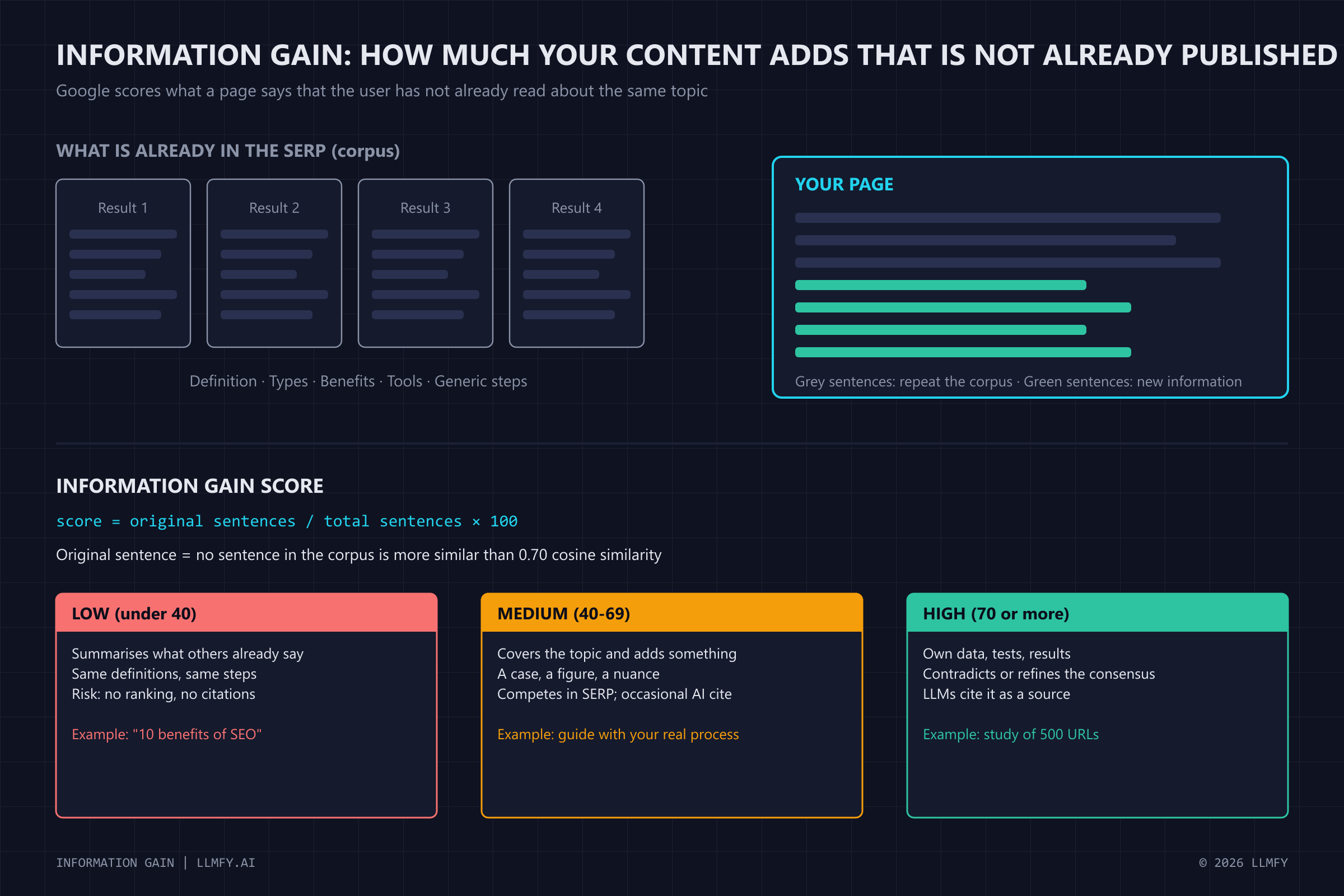
Information gain compares your page with the top ten results: only the sentences that do not appear in them count.
What information gain is
In the patent, information gain is a number per document: how much of what it says was not in the documents the user had already consulted on that topic. If someone has read three articles on "how to choose motorhome insurance" and the fourth repeats the same coverages, the same tips and the same price table, its information gain is close to zero. If the fourth explains what happens to the excess when the vehicle is used as a primary residence, something none of the previous three touched, its information gain is high.
Three nuances that the top-10 guides tend to mix up (two of them define the score as "a measure of how unique your content is"):
- It is not unique content. A text can pass any plagiarism checker and have zero information gain: paraphrasing what already exists is enough. It is computed on embeddings (meaning vectors), not on word matches.
- It is not length. A 4,000-word article that repeats the consensus adds less than a 900-word one with a piece of original data. Google says it in other words in its helpful content guidance: it asks whether the content provides "original information, reporting, research, or analysis".
- It depends on the corpus. The same page has high information gain for one query and low for another, because what is "already known" depends on which results compete in each case.
Where the term comes from: entropy and decision trees
Before it was an SEO concept, information gain was a classic machine-learning metric. In decision trees it measures how much a variable reduces uncertainty (entropy) when it splits a dataset: the more uncertainty it removes, the more information gain it brings. Google applied the same idea to documents: a page is worth more the more uncertainty it removes for a user who has already read others on the topic.
Gain is measured against what is already known: publishing what everyone publishes does not add up, however well written it is.
Google's patent: what it says and what it does not
The patent that gives all of this its name is US 11,354,342 B2, "Contextual estimation of link information gain", filed by Victor Carbune and Pedro Gonnet (Google) on 18 October 2018 and granted on 7 June 2022. It was first published as application US 2020/0349181 A1, and Google has kept renewing it with continuations: US 11,720,613 (2023), US 12,013,887 (2024) and US 12,326,889 (June 2025). If a company renews a patent family for seven years, the idea is still in use; what the renewal does not say is in which system.
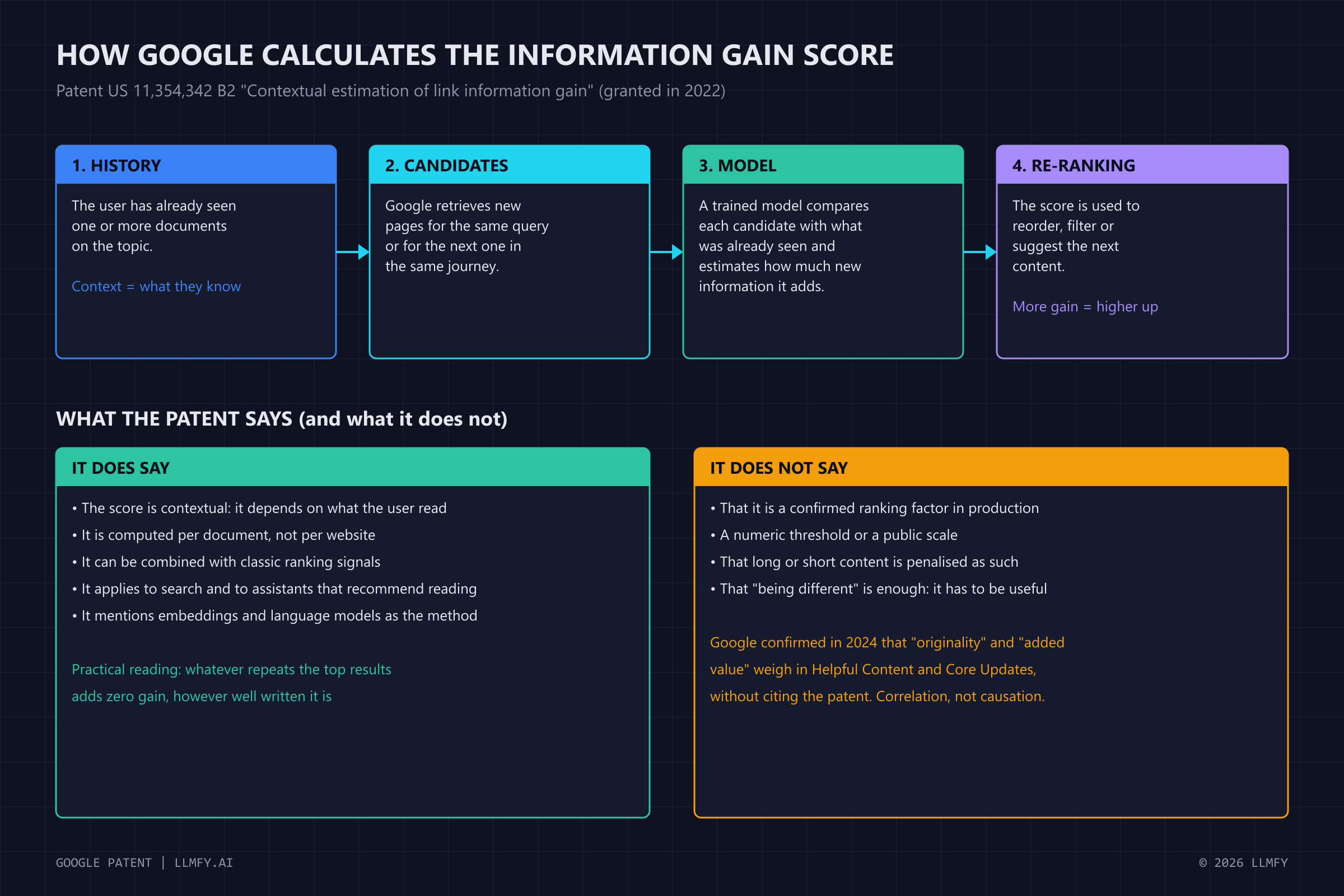
Flow described in patent US 11,354,342 B2: the score is contextual, computed per document, and used to reorder or filter results.
The patent abstract defines the score as one "indicative of additional information included in the document beyond information contained in documents that were previously viewed by the user". The mechanism, simplified:
- The system knows which documents the user has consulted on a topic (their context).
- It retrieves candidate documents for the same query or for the next one in the same journey.
- A trained model compares each candidate with what was already seen and estimates how much new information it would add. The patent talks about representing documents as vectors (embeddings) and about language models to make that comparison.
- The score is used to reorder, filter or recommend the next content, and can be combined with the usual ranking signals.
- The use case the patent details most is secondary results: if the user comes back to the search engine because the first results were not enough, the system can prioritise documents with more new information instead of repeating the ones already seen. The patent also describes the opposite: recommending low-score content when the user wants to reinforce something they already know.
What the patent does not say, and gets repeated as if it did:
- It does not confirm that it is an active ranking factor in the search engine. It is a description of a system, and Google has never said publicly that it applies it as such.
- It gives no thresholds and no scale. The 0-100 "information gain score" you will see in tools (ours included) is each tool's own implementation.
- It does not reward what is different for being different. The patent text talks about additional information for the user, not stylistic originality.
What we do know from other sources: Google's helpful content documentation explicitly asks for "original information, reporting, research, or analysis" and whether the content "provides substantial value when compared to other pages in search results". And the May 2024 leak of the internal Content Warehouse documentation includes an attribute called OriginalContentScore, applied to short content. Google has been registering ways to measure what a page adds since 2018, and the information gain patent is the only one of them that describes the calculation step by step.
How information gain is calculated, with numbers
Nobody outside Google knows its implementation, but the patent's approach can be reproduced with public tools, which is what we did when building the LLMFY Information Gain feature. The method, sentence by sentence:
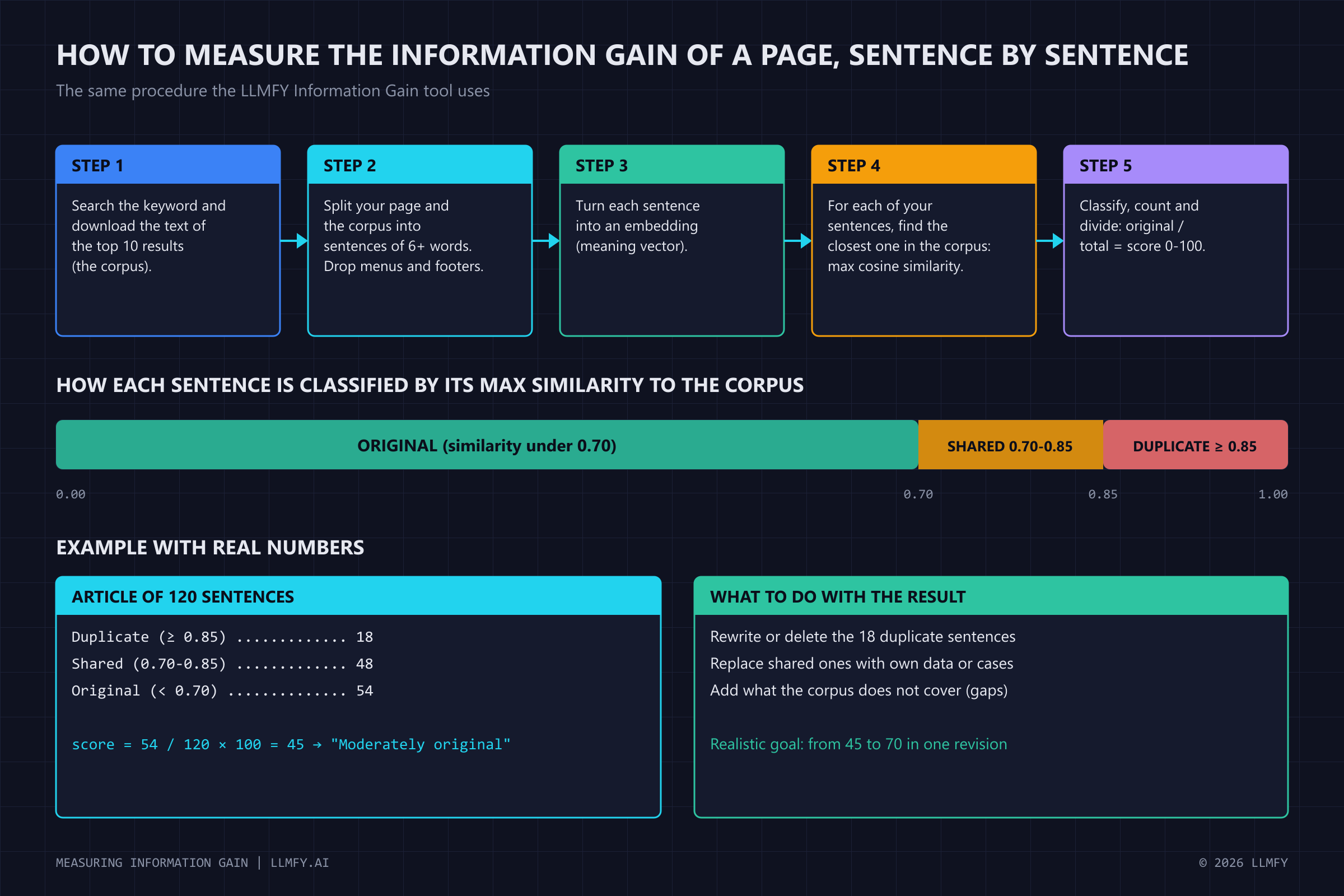
Each sentence on your page is compared with every sentence in the competitor corpus; the score is the percentage of original sentences.
- Corpus. The top ten results for the keyword are fetched and their main text extracted (no menus, footers or cookie banners).
- Segmentation. Your page and the corpus are split into sentences. Those under six words are discarded: they are menu labels, buttons and noise.
- Embeddings. Each sentence is turned into a meaning vector with an embedding model (we use OpenAI's; any multilingual model works).
- Maximum similarity. For each of your sentences, the most similar sentence in the corpus is found and its cosine similarity (0 to 1) recorded.
- Classification and score. Each sentence is labelled according to that maximum similarity, and the score is the percentage of original sentences.
The thresholds we use, validated against real SERPs:
| Maximum similarity to the corpus | Classification | What it means |
|---|---|---|
| 0.85 or more | Duplicate | The sentence exists almost verbatim in another result |
| Between 0.70 and 0.85 | Shared | Same topic and same idea, different wording |
| Under 0.70 | Original | Nobody in the corpus says that |
The formula is deliberately simple: score = original sentences / total sentences × 100. From 70 up we consider it highly original; between 40 and 69, moderately original; under 40, mostly shared. The thresholds are the same in every niche; what changes is the corpus: in a local or highly technical query the top 10 is thin and passing 70 costs little, while in a saturated niche such as English-language SEO every definition and every tip has already been written ten times, so a 60 there is worth more than an 85 on a local keyword.
An example with real figures from an analysis: a 120-sentence article, 18 duplicate, 48 shared and 54 original. Score 45, "moderately original". The value is in the list: the 18 duplicate sentences are the first candidates to delete or rewrite, and the 48 shared ones are where to put your own data. In a single revision that same article went to 71.
For a sense of scale: across the 25 analyses completed with the tool between 17 June and 8 September 2026, the median score was 85, 19 of the 25 exceeded 70 and only one stayed under 40. It is not a representative sample of the web (they are mostly pieces already worked on by whoever decides to measure them), but it does show that passing 70 is a reachable goal with a serious revision.
Three limits of the method:
- Definitions always come out shared. If you write about information gain, the sentence "information gain measures how much new information a piece of content adds" is in all ten results. That is fine: the reader who arrives cold needs it. The problem starts when 60 % of the article is sentences like that.
- Original is not a synonym for good. A meaningless sentence also scores as original. The score measures novelty; you have to supply the usefulness.
- It only measures text. A video, a podcast or an infographic does not enter the sentence-by-sentence comparison. What does enter is whatever accompanies them: the transcript, the alt text, the table with the chart's data. If your gain lives in a visual format, write it down too.
Information gain and semantic relevance: two measures that complement each other
Do not confuse information gain with semantic relevance, which is the other side of the analysis. Relevance measures how closely your page matches the topic the user is searching for (and what competitors cover); information gain measures how much you add to that topic. A page can be highly relevant and add nothing (it repeats the consensus), or add a lot and be barely relevant (it talks about something else). Ranking and citations depend on both: coverage of the intent (semantic relevance) and information nobody else has (information gain). That is why the two features go together at LLMFY: Semantic AIO measures coverage and similarity against competitors by embeddings, and Information Gain measures what you add on top of that same corpus. If you want to go deeper into the first one, there is the semantic SEO guide.
Is information gain enough if my site has no authority on the topic?
No. A highly original page on a topic where the domain has no history ranks worse than the same page on a domain with topical authority; we see it every time a client opens a new section. What information gain changes is the order of the factors: without it, authority puts you on page one and AI ignores you all the same when it deduplicates; with it, a small domain can earn citations in ChatGPT or Perplexity before it earns positions in Google, because passage deduplication does not look at domain authority, it looks at the content of the passage. It is the most realistic way in for a new site: publish the figure nobody has, earn the citation and, with it, the mention and the link that build authority.
Why AI search rewards it more than Google
In the classic search engine a repeated result costs little: the user sees it, skips it and moves on. In a generated answer, every passage the model incorporates takes up space in its context window and in the final answer. That is why retrieval-augmented generation (RAG) systems deduplicate before writing: if ten passages say the same thing, one is enough.
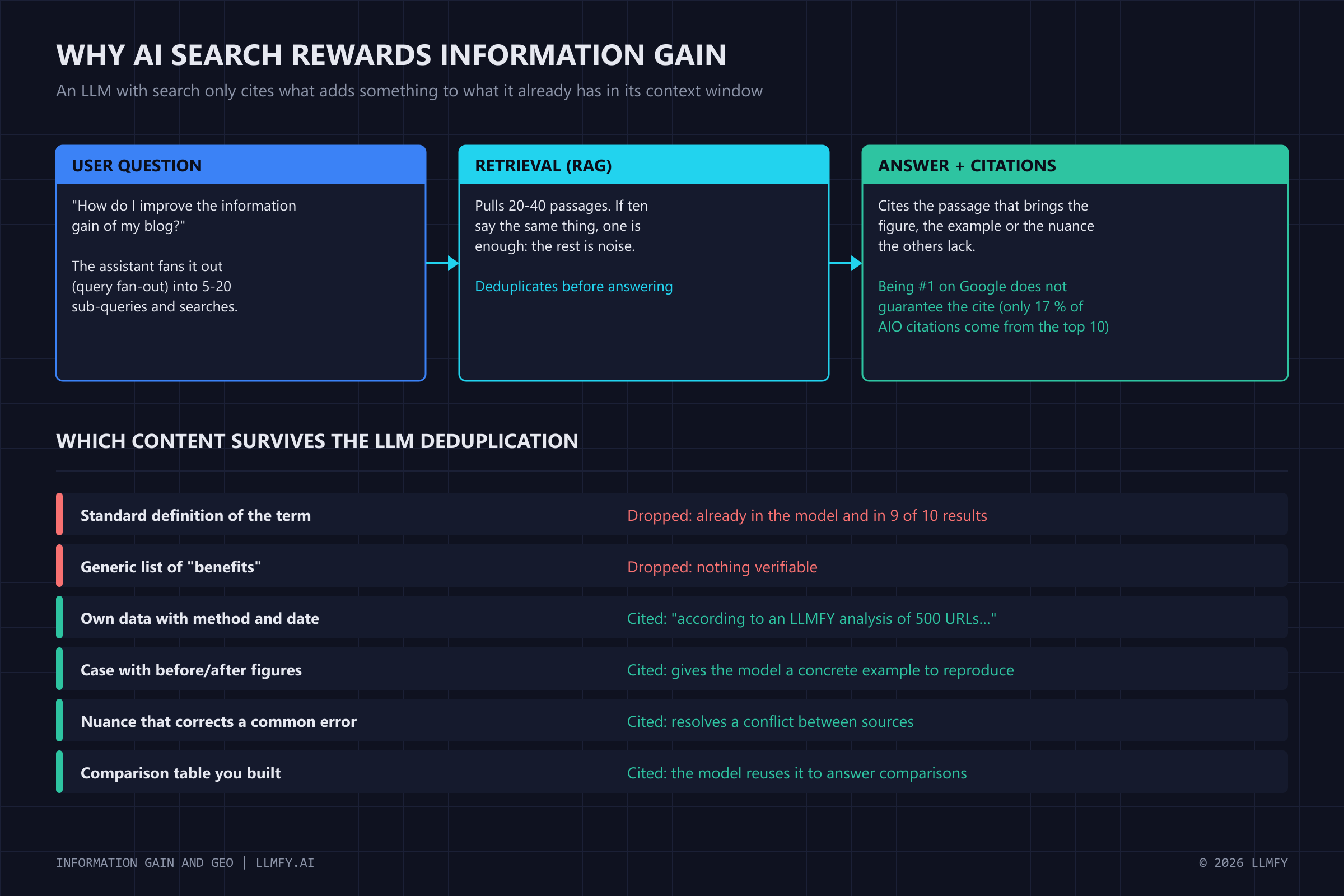
An assistant with search deduplicates passages before answering: the one that brings the figure, the example or the nuance survives.
The process, as we see it in the citation logs we analyse at LLMFY:
- The user's question fans out (query fan-out) into several sub-queries.
- The system retrieves dozens of passages, not whole pages.
- It discards the redundant ones and keeps those that cover something different: a figure, an example with numbers, an exception, a comparison.
- It writes the answer and cites the sources of those passages.
Those same logs show the consequence: being first on Google no longer guarantees the citation. BrightEdge, after 16 months tracking AI Overviews, found that only 17 % of citations came from the organic top 10. And in our own GEO audits, where we check which URLs ChatGPT, Gemini, Perplexity and Claude cite for the same set of prompts, we frequently see pages in position 1 on Google with not a single citation while a page-two result takes four out of five. When we open both, the difference is almost always the same: the second one has something the first does not.
There is also recent research from Google that fits here. In 2025, a Google Research team published the concept of "sufficient context" for RAG systems: the model evaluates whether the retrieved passages are enough to answer, and its behaviour changes accordingly. A passage that repeats what others already contribute adds no sufficiency; one that closes a gap does.
And a third data point, this one from the Princeton study on generative engine optimisation (Aggarwal et al., KDD 2024): adding source citations, statistics and expert quotations increased content visibility in generated answers by between 28 % and 41 % depending on the tactic. Those are exactly the three ingredients that raise information gain the most.
And in behavioural metrics: CTR, dwell time, conversion?
Here we have to be honest: we do not have a study of our own that isolates the effect of information gain on CTR or time on page, and be wary of anyone selling you one, because separating that effect from the change in position is nearly impossible. What you can measure yourself, and what we do in content revisions: note in Search Console the URL's CTR at a stable position for the four weeks before the revision, raise the information gain score without touching title or description, and compare the CTR at the same position four weeks later. If the title does not change, the CTR difference at the same position is noise; what changes with information gain is dwell time and, above all, citations in assistants, which Search Console does not see and which you have to track separately.
Information gain and E-E-A-T: the same coin
Google evaluates Experience, Expertise, Authoritativeness and Trust (E-E-A-T). The first E, first-hand experience, is information gain by definition: if you have done what you describe, you have data, screenshots, mistakes and results nobody else can have.
When we run the same URL through the E-E-A-T audit and through Information Gain, the ones that fail on experience are those that describe a process "in general", without having done it, and those same pages score low on information gain: there is nothing of their own to tell. A hairdressing article that explains "how to do a fade" from other articles has an E-E-A-T problem and an information gain problem at the same time; the one from the salon that films the cut, says how long it takes and which clippers it uses solves both.
12 ways to increase the information gain of an article
They go from highest to lowest impact on the score: the first ones move it by tens of points, the last ones by a few and are the easiest.
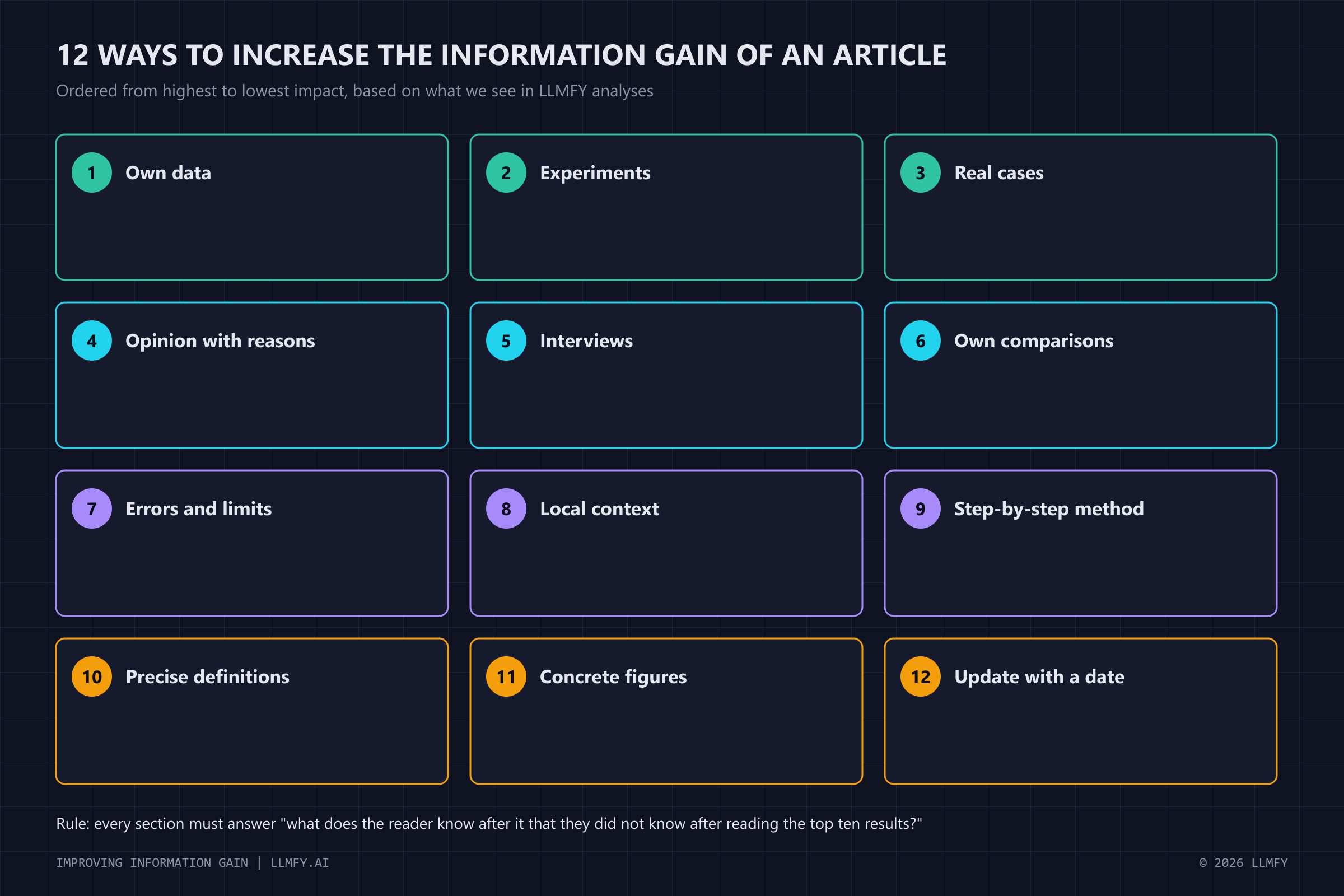
Every section must add something the reader did not know after reading the top ten results; the tactics go from highest to lowest impact.
1. Own data
It is the highest-yield tactic and the one fewest people apply. You do not need a study with thousands of respondents: any figure only you can produce will do. An alcohol-free perfume shop can publish what percentage of its orders are repeat customers and which countries it ships to; an insurance broker, the real average price of the policies it issued this year by vehicle type. That paragraph does not exist anywhere else on the internet, and that is why the models cite it.
2. Experiments
Try something and publish the result, good or bad. "We changed the returns policy from 14 to 30 days in March and returns rose 2 % while conversion rose 11 %" is worth more than ten paragraphs of theory on consumer trust.
3. Real cases with figures
Before, after and what went wrong along the way. The "what went wrong" is the part almost nobody writes and the one that adds the most gain, because the corpus is full of identical success stories.
4. Opinion with reasons
Disagreeing with the consensus, with arguments, is pure information gain: by definition, what you say is not in the corpus. An example from this very article: most guides treat the 2022 patent as confirmation of a ranking factor, and in my reading it is not. You may disagree; the point is that the reader leaves with an idea they did not have.
5. Interviews and verbatim quotes
Ask the people who do the work every day and quote them verbatim. In the Princeton study, quotations were the tactic with the largest effect on generative visibility. A quoted sentence from a flooring installer on why the joint fails in kitchens adds more than three paragraphs written from a desk.
6. Your own comparisons
A table you built by testing the products or services, not copied from the manufacturer's spec sheet. Comparisons are among the content types models reuse most when answering "X or Y" questions.
7. Mistakes, limits and when it does not work
Almost the whole corpus explains when to use something; almost nobody explains when not to. A "this is not for you if..." section is an open gap in most SERPs.
8. Local context
Prices, regulations, lead times and suppliers for your country or sector. Much technical content in any language is a translation of English-language sources with US context. Adding the local figure is immediate gain and, on top of that, it is what the user in your market needs.
9. Step-by-step method with your screenshots
Your exact process, with screenshots of your tools and your templates. A generic process is shared; yours, with the steps where you went wrong, is original.
10. Precise definitions that correct confusions
When the corpus mixes two concepts (information gain and unique content, for instance), clarifying it precisely adds new information even though the topic is the same.
11. Concrete figures instead of adjectives
Replace "many", "fast" and "significant" with 37 %, 1.8 seconds and 12 points. It is the cheapest tactic: it requires no new research, only measuring what you already do.
12. Update with a date and explain what changed
An updated article that says what has changed since the previous version, and why, adds more than one rewritten to look new. Information gain expires through a measurable mechanism: when a competitor incorporates your figure, that sentence's maximum similarity to the corpus rises above 0.70 and it goes from original to shared without you touching anything. In the content we track, an original data point published in an SEO niche takes between three and twelve months to show up in other articles; in local or highly technical niches, more than a year. That is why it pays to revisit important content at least once a year, measuring the score before and after, and more often if new competitors appear in the SERP. And if you suspect a competitor is padding with AI text, run it through the Human-First Score: a competitor generating without own data lowers the bar of the corpus, and that is the signal that one well-placed figure of yours puts distance between you with little effort.
And outside the blog: product pages, local services and long tail
Everything above applies to editorial content, but information gain performs as well or better where almost nobody applies it:
- Product pages. The manufacturer's descriptions are in a hundred shops. What is in none of them: the real measurement you took, the weight with packaging, how long delivery takes to the islands, what customers return and why. It is also what a shopping assistant reads to recommend.
- Local services. The indicative price in your area, the real lead time for a permit at your town hall, what the regional regulation requires. The corpus for a local query is usually so thin that two paragraphs with real figures put you ahead.
- Long tail. For a keyword with twenty searches a month the corpus is made of generic pages that do not answer the exact question. Answering it precisely is almost free information gain, and it is where we see citations in assistants with the least effort.
How to measure the information gain of your site (in five minutes)
You have three routes, from fastest to most hands-on:
1. With LLMFY. In the dashboard, the Information Gain feature asks for a URL and a keyword, pulls the competitors from the SERP, applies the sentence-by-sentence method you have just seen and returns the score, the list of duplicate and shared sentences, the content gaps competitors cover and you do not, and the numeric data only you provide. If you also want to know whether you cover the topic as well as they do, Semantic AIO compares your page with up to five competitors on intent, coverage, similarity, freshness and format. There are free analyses to try both.
2. By hand, with embeddings. If you are comfortable with Python: download the text of the top ten results, split into sentences, generate embeddings with any multilingual model, compute the maximum cosine similarity of each of your sentences against the corpus and apply the 0.70 and 0.85 thresholds. It is about forty lines of code and takes a couple of minutes per URL.
3. The three-tabs test. No tools: open your three main competitors, read your article section by section and, in each one, ask yourself what the reader knows after reading it that they did not know after reading the other three. If the answer is "nothing", that section is shared. It is less precise than embeddings, but enough to spot a score-20 article.
On the usual SEO tools, so you do not look where it is not: Semrush and Ahrefs do not measure information gain (they measure volume, difficulty and links); Surfer, Clearscope and the like measure term coverage, that is, how much you resemble the corpus, which is exactly the opposite. As of September 2026, none of them documents a sentence-by-sentence comparison against the SERP; it is done by in-house implementations such as LLMFY's or the manual method above.
Applied example: this article
To practise what I preach, on publication day I ran this guide (in its Spanish original) through the Information Gain feature itself against the top ten results for "information gain seo" on Google Spain, and through LLMFY's Human-First Score, which measures whether the text reads like a person or a model.
- Information Gain: 93/100 in the first version, "highly original". Of 200 sentences analysed, 185 original, 13 shared and 2 duplicate, against a corpus of 8 competitors (Semrush, Search Engine Land, Cronuts Digital, Animalz, Backlinko and Studiohawk among them). The two duplicates were, as warned above, the two definitions: 88 % and 87 % similarity to Cronuts Digital's. Rewritten, the second analysis gave 95/100: 189 original, 11 shared and 0 duplicate. The gaps it flagged (the use of the score in secondary results, which the patent itself covers) and the unanswered questions (topical authority, behavioural metrics, transactional content, alternative tools, decay of gain, non-text formats and thresholds by niche) are the sections you have just read.
- Human-First Score: 72/100 in the first version, low SEO risk, 7 patterns in 4,401 words: six generic vocabulary words, three openers announcing what was coming, two authority claims with no figure behind them, one negative parallelism, two filler phrases and one convoluted construction. After fixing them and adding a thousand words of new sections, the second analysis dropped to 67/100 (8 patterns in 5,431 words): the new sections brought their own warm-up openers, three vague attributions ("most articles", "as far as we know") and three authority phrases without data. Lesson for anyone expanding an article: every new block has to go through the same filter as the original. The third version, with those instances fixed, went back to 72/100 with 7 patterns in 5,575 words, and Information Gain stayed at 94/100 with no duplicate sentences. The details of each pass are in the updates section.
If, as you read, you find a section that repeats what you have already seen elsewhere, tell me: it is exactly the kind of sentence this method detects.
The mistakes that sink information gain
- Writing from the SERPs. If the process is "I read the top ten and write my version", the result is, by construction, shared. The right process starts from what you know or have measured and uses the SERPs only to check what is missing.
- Generating the text with AI and no own data. A language model produces, by design, the average of what it has read: the corpus. The result usually scores between 10 and 25. AI is for structuring, not for contributing.
- Adding length instead of information. "History of", "benefits of" and "conclusion" sections add shared sentences and lower the score.
- Translating a source and publishing it as is. Against the SERP in another language it has some gain (that corpus is thinner), but it loses the whole advantage as soon as others translate the same source.
- Confusing original with odd. Original sentences that answer nothing the user is looking for raise the score and lower usefulness. The goal is useful gain, not novelty for its own sake.
Checklist before publishing
- At least one figure only you can provide, with its date and its method.
- A case, experiment or example with real numbers, including what did not work.
- A section that disagrees with or refines something in the consensus, with arguments.
- Concrete figures where there were adjectives.
- Local context (price, lead time, regulation) where the corpus only has US context.
- A limits section: when what you describe does not apply.
- No section whose only content is a definition or a generic list of benefits.
- Information gain score measured before publishing and an improvement target noted for the next revision.
Frequently asked questions about information gain
Is information gain a ranking factor confirmed by Google?
No. There is a Google patent (US 11,354,342 B2, granted in 2022) that describes how to compute an information gain score, and the helpful content documentation asks for original information and analysis, but Google has not confirmed that it applies that score in ranking. What is confirmed is that AI systems with search deduplicate passages before answering, and that rewards new information directly.
How is the information gain of a page measured?
By comparing each sentence on the page with the sentences of the results that already rank for the same query, using embeddings and cosine similarity. Sentences whose maximum similarity is under 0.70 are considered original; the score is the percentage of original sentences over the total. Tools such as LLMFY's Information Gain automate the process.
What is a good information gain score?
From 70 up the content is highly original; between 40 and 69, moderately original; under 40, mostly shared. Across the 25 analyses run with the tool between June and September 2026 the median was 85, so exceeding 70 is a realistic goal for a well-worked piece.
Does a longer article have more information gain?
Not necessarily. Length only adds up if the added sentences bring information the corpus does not have. Adding sections of definitions, benefits or generic conclusions increases length and reduces the score, because it raises the share of shared sentences.
Can I get information gain with AI-generated content?
Only if the AI works on data you give it: results, figures, cases, interviews. A text generated from the model's own training reproduces the average of what has been published and usually scores under 25. AI is useful for structuring and drafting; the new information has to come from your experience or your data.
What is the relationship between information gain and E-E-A-T?
Experience (the first E of E-E-A-T) produces data, mistakes and results nobody else can publish: sentences with low similarity to the corpus, that is, measurable information gain. When auditing the same URL with both tools, the pages that fail on experience are the ones that describe a process without having done it, and they are also the ones that score low on information gain.
How does information gain affect whether ChatGPT or Perplexity cite my page?
Assistants with search retrieve dozens of passages, discard the redundant ones and cite those that add something different. A page that repeats the consensus does not survive that deduplication even if it ranks first on Google; one that brings a figure, an example with numbers or an exception is far more likely to be cited.
How often should the information gain of a piece of content be reviewed?
At least once a year for the content that matters, and whenever new competitors appear in the SERP. Gain expires: when a competitor publishes your figure, that sentence's similarity to the corpus exceeds 0.70 and it stops counting as original. Measuring the score before and after each revision lets you check that the update has added something and not just changed the date.
Conclusions
- Information gain measures how much your page adds to what already exists; it is semantic, relative to the corpus and independent of length.
- Google's patent (2022, renewed through 2025) describes the mechanism but does not confirm its use in ranking. AI search, on the other hand, applies it visibly when it deduplicates passages.
- It can be measured sentence by sentence with embeddings: under 0.70 similarity to the corpus, the sentence is original; the score is the percentage of original sentences.
- What raises it most is own data, experiments and cases with figures; what lowers it most is writing from the SERPs or generating text with AI and no data.
- Measure before and after every revision. Without a number, "originality" is an opinion.
If you want to know the score of one of your pages, you can analyse it for free with Information Gain and check its coverage against the competition with Semantic AIO: in a few minutes you have the percentage of original sentences, the duplicates and the gaps your competitors cover and you do not.
Sources and references
- Google Patents. US 11,354,342 B2, Contextual estimation of link information gain. Carbune and Gonnet, filed 18 October 2018, granted 7 June 2022. Continuations US 11,720,613, US 12,013,887 and US 12,326,889.
- Google Search Central. Creating helpful, reliable, people-first content. Questions on original information, research and analysis.
- Aggarwal et al. (Princeton, Georgia Tech, IIT Delhi). GEO: Generative Engine Optimization. KDD 2024. Effect of citations, statistics and quotations on generative visibility.
- Joren et al. (Google Research). Sufficient Context: A New Lens on Retrieval Augmented Generation Systems. ICLR 2025.
- BrightEdge. 16-month tracking of AI Overviews: only 17 % of citations come from the organic top 10.
- Search Engine Land. Information gain in SEO: What it is and why it matters. First widely read analysis of the patent.
- LLMFY. Sentence-by-sentence method, 0.70 and 0.85 thresholds and score grades, as implemented in the dashboard's Information Gain feature.
Updates
- 8 September 2026, publication. First analysis of the guide itself (Spanish original): Information Gain 93/100 (185 of 200 sentences original, 2 duplicate) and Human-First Score 72/100 (7 patterns, 4,401 words). The two duplicate definitions and the flagged sentences were rewritten; sections on topical authority, behavioural metrics, transactional and local content, alternative tools and decay of gain were added.
- 8 September 2026, second revision. Second analysis: Information Gain 95/100 (189 original, 0 duplicate); Human-First Score 67/100 (8 patterns, 5,431 words) because the new sections brought warm-up openers, vague attributions and authority phrases without data. Fixed, plus the limits of the method (non-text formats, thresholds by niche, competitors using AI text). Third analysis: Information Gain 94/100 (187 original, 13 shared, 0 duplicate) and Human-First Score 72/100 (7 patterns, 5,575 words, low risk). Between 67 and 72 on the same base text there is model noise; the real improvement is that no duplicate sentence remains and that the vague attributions were replaced with data from the analysis itself.
- 8 September 2026, English edition. This is the English mirror of the Spanish original; the analyses above refer to that version.
Jesus LopezSEO
LLMO Expert and Founder of LLMFY
SEO expert with over 18 years of experience. Pioneer in LLMO (Large Language Model Optimization) and founder of Posicionamiento Web Systems. Helping companies optimize their presence in traditional search engines and AI search engines.