Parasite SEO in 2026: What It Is + Parasite AI SEO Explained
I've been doing SEO for over 18 years, and I've watched parasite SEO get declared dead at least four times. Google's Site Reputation Abuse policy in 2024 was supposed to be the final nail in the coffin. It wasn't. Parasite SEO didn't die — it mutated. And in 2026, it's quietly become one of the most powerful tools in a completely different game: getting your brand cited by ChatGPT, Perplexity, Gemini and Google AI Overviews. In one sentence: parasite SEO is publishing content on high-authority third-party platforms to benefit from their rankings — and, in 2026, to teach AI systems to cite your brand. Parasite AI SEO is the AI-first version of the same tactic: using those platforms so ChatGPT, Perplexity and AI Overviews cite your brand.
Here's the thing nobody in the "parasite SEO guides" ecosystem is telling you: every single guide out there — and I've read them all — treats parasite SEO as a way to rank pages in Google. That's the old game. The new game is that LLMs build their answers from the exact same high-authority platforms that parasite SEO has always targeted. Reddit threads. Trustpilot categories. Industry directories. Niche publications. When someone asks ChatGPT "what's the best maxillofacial surgeon in Madrid?", the model isn't crawling your website in real time — it's synthesizing what it learned from the sources it trusts.
Which means the parasite placement you publish today isn't just a page that might rank. It's a co-citation seed inside the corpus that AI systems consult when they decide which brands to recommend.
This is parasite AI SEO — what my agency calls Parasite SEO for AI Building — and in this guide I'll show you exactly what it is, how the classic tactic works in 2026, which platforms feed which AI engines, the step-by-step framework we use with real clients, and the CRM-verified results that convinced me this is where the discipline is heading.
What Is Parasite SEO? (The 2026 Definition)
Parasite SEO is the practice of publishing content on high-authority third-party platforms — directories, communities, publications, review sites — to benefit from their domain authority, editorial trust and crawl frequency instead of relying solely on your own domain.
The mechanics haven't changed since the term was coined: Google (and now, AI systems) trusts certain hosts enormously. A brand-new article on your two-year-old domain competes from the bottom. The same article published on a platform with a domain rating in the 90s starts the race three laps ahead.
What has changed is the payoff. In the classic model, the win was a ranking: your parasite page appears in position 3 for a commercial keyword and funnels traffic to your offer. In the AI-era model, the win is a citation pattern: your brand appears consistently in the sources LLMs synthesize, so the models start recommending you by name — even in conversations where no search result is ever shown to the user.
Same tactic. Different scoreboard.
Does Parasite SEO Still Work in 2026?
Yes — but the version that works looks nothing like the 2019 version, and pretending otherwise gets accounts banned and budgets burned.
Three forces reshaped the practice:
Google's Site Reputation Abuse policy (2024, refined through 2025). Google now explicitly targets third-party content published on a host mainly to exploit that host's ranking signals — think coupon pages on newspaper sites with zero editorial connection. Thin, mismatched parasite content gets deindexed. Content that genuinely belongs on the host platform survives and thrives.
The community-content surge. Google deliberately pushed Reddit, forums and community answers up the SERPs, and "best X reddit" became a native search pattern. Communities went from a parasite side-channel to prime real estate.
AI answers replaced clicks. AI Overviews and chat assistants now resolve a growing share of commercial queries without a single click to any website. If your visibility strategy ends at "rank the page," you're optimizing for a shrinking surface.
The 2026 conclusion: parasite SEO works when the content deserves to exist on the host platform, and its highest-leverage use case is no longer the ranking itself — it's what that placement teaches the AI systems about your brand.
White Hat, Grey Hat and Black Hat Parasite SEO: The Three Risk Tiers
Not all parasite SEO plays in the same risk league, and confusing the tiers is the fastest way to burn budget:
- White hat: genuinely useful content published where it belongs, respecting platform rules, with real editorial oversight from the host. It's the only lane we run at the agency and the only one that survives the 2026 policies.
- Grey hat: decent content, but hyper-optimized and placed mainly for the host's ranking signals — mass sponsored posts, rented subfolders with minimal oversight. It works until it doesn't, usually one update later.
- Black hat: spam content, injected links, fake accounts, placement networks. Near-guaranteed deindexing and — worse for AI Building — negative sentiment permanently encoded into the corpus the models consult.
The Regulatory Front: Google vs. the European Commission (DMA)
The Site Reputation Abuse policy opened a second front almost no guide mentions: the regulatory one. In late 2025 the European Commission opened an investigation under the Digital Markets Act into whether Google, by penalizing commercial content hosted on publisher sites, is unfairly restricting legitimate publisher monetization models. Google argues its anti-spam policy protects users — a German court had already dismissed a similar claim — and in 2026 it has proposed changes to its search product in the EU to settle the case.
For anyone running parasite SEO, the practical read is twofold: enforcement may fluctuate in Europe while the standoff lasts, but betting your strategy on a regulator restraining Google is speculation, not strategy. Content that deserves to exist on its platform is immune to the outcome of the case.
Parasite AI SEO: Why LLMs Moved the Game From Rankings to Co-Citations
To understand why parasite placements are so valuable for AI visibility, you need to understand how LLMs decide what to recommend.
When a language model answers "which insurance broker do you recommend for campervan insurance in Spain?", it draws on two layers:
- Training data — the corpus the model learned from, where platforms like Reddit, Wikipedia, Trustpilot, major directories and established publications are massively overrepresented because of their size, authority and crawlability.
- Retrieval — for AI systems with live search (Perplexity, ChatGPT Search, AI Overviews, Copilot), the sources fetched at answer time, which skew heavily toward the same high-authority platforms, because that's what ranks.
In both layers, your own website is a minority voice. What moves the needle is how often your brand appears — favorably, consistently, and in context — across the sources the model already trusts. In LLMO we call these co-citations: your brand name appearing next to the topic, on platforms the AI treats as ground truth.
This is the concept I've been calling AI Building since I founded LLMFY — the AI-era successor to link building. Link building earns votes for your domain. AI Building earns mentions for your entity. And parasite SEO turns out to be the most operationally mature toolkit ever developed for placing content exactly where those mentions count. The full theory is in our LLM Optimization guide, and the trust mechanics are covered in E-E-A-T for LLMs.
One important nuance most people miss: a parasite page that never ranks #1 can still be an AI Building success. If a detailed Reddit answer mentioning your brand sits in a thread the model retrieves, you win the citation even if that thread sits in position 8. Rankings are binary and winner-takes-most; co-citations are cumulative. That completely changes what "success" means for each placement.
The Platform-to-AI-Engine Map
Not all parasite platforms feed all AI engines equally. This is the map we use at the agency, built from monitoring client citations across engines:
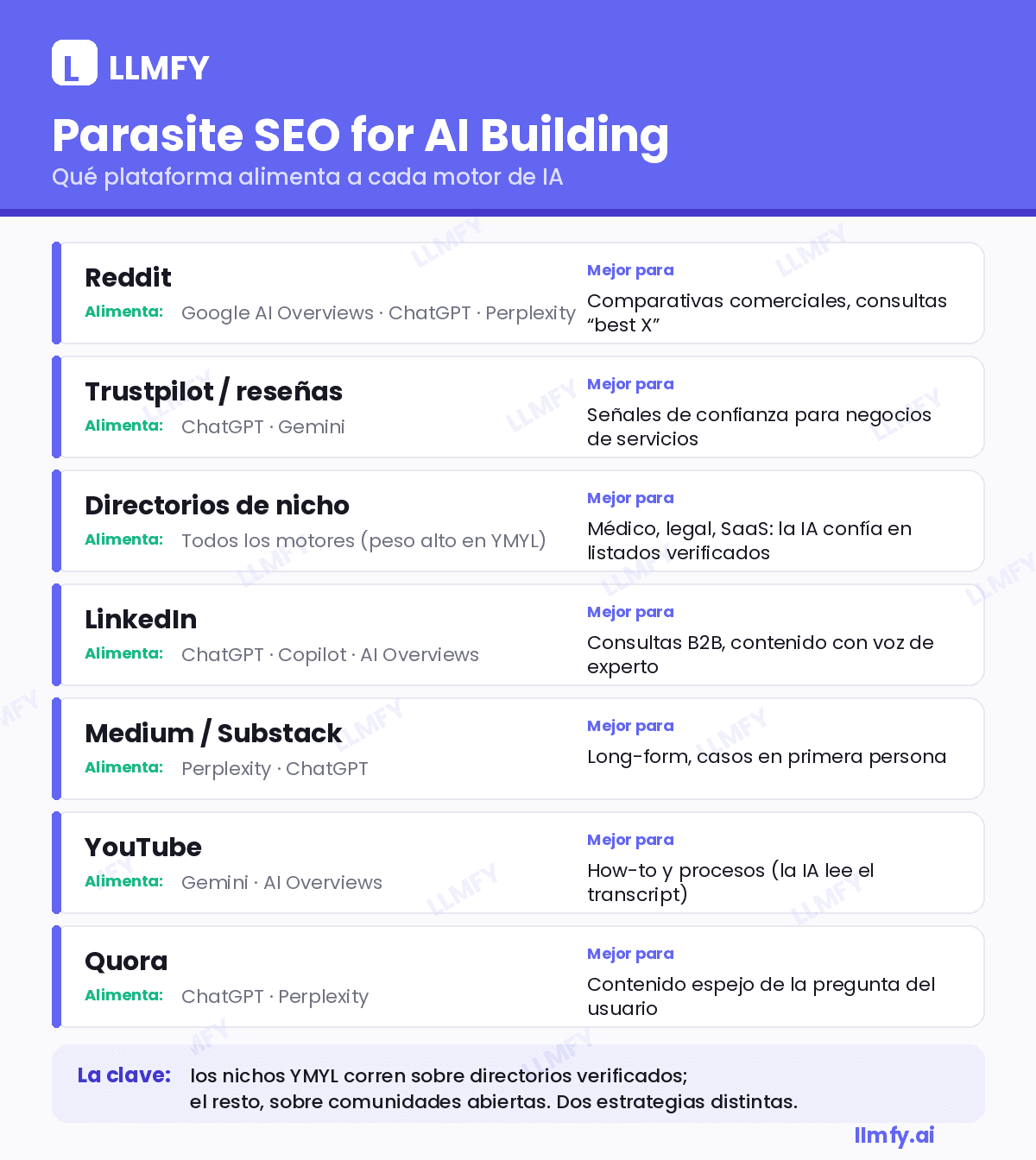
The strategic insight from this map: YMYL niches (health, finance, legal) run on gatekept directories, while everything else runs on open communities. That distinction defines the two lanes of the framework below.
Parasite Platforms by Market: Where It Actually Works
The global map gets concrete differently in each market. In English-speaking markets: major media with branded-content programs for editorial authority, trade and niche publications for B2B, vetted vertical directories (medical, legal, SaaS review hubs) for anything YMYL, and Reddit, Quora and specialist forums as the community layer. In non-English markets — Spain is the case we know best — vertical directories carry proportionally more weight, because there are fewer community threads in the local language with enough authority to get retrieved.
The rule doesn't change: run your prompts through each engine and let the cited sources tell you which platforms actually matter in your niche and language.
How to Do Parasite AI SEO: The AI Building Framework (Step by Step)
This is the exact process we run monthly for agency clients. It splits into two lanes because gatekept platforms and open platforms require completely different plays.
Step 1: Map the prompts, not just the keywords
Start with 15–20 conversational prompts your buyers actually ask AI systems ("best campervan insurance Spain", "is X clinic good for orthognathic surgery"). Run them across ChatGPT, Perplexity, Gemini and AI Overviews. Log two things: which brands get recommended and which sources get cited. That source list is your parasite target list — no guesswork required. The engines are telling you where they look.
Step 2: Lane A — dominate the gatekept directories
For every vetted directory that appears in your citation log (medical directories, G2-style review hubs, professional registries): claim and maximally complete your profile. Not "present" — complete. Credentials, photos, services, FAQs, response to every review. LLMs reward completeness because complete profiles are easier to extract facts from. In YMYL niches this lane alone can account for most of your AI visibility.
Step 3: Lane B — earn your place in open communities
For Reddit, Quora and forums: participate before you place. Our rule is 30 days of genuinely useful, link-free participation in target communities before any content that mentions the brand. Then publish answer-shaped content: first-person, specific, with real data, matching the exact question of a thread that already ranks or gets retrieved. One deeply useful answer in the right thread outperforms twenty promotional posts — and survives moderation.
Step 4: Publish citable assets, not ads
Every placement follows the same content bar: minimum ~800 words for written formats, first-person experience framing, at least one specific data point or outcome, and structured formatting (clear question-answer blocks) that models can lift cleanly. If you've read our Schema for LLMs guide, you already know why machine-liftable structure wins — the same logic applies to content you publish on hosts you don't control.
Step 5: Interlink the cluster, lightly
Your own site publishes the definitive guide; parasite placements cover angles (an experiment on Medium, a founder take on LinkedIn, a process video on YouTube, an answer on Reddit). Reference each other only where it genuinely helps the reader. The goal is a small constellation the AI keeps bumping into, not a link wheel.
Step 6: Measure citations, not just rankings
Track three metrics monthly: (1) brand mention rate across your prompt set per engine, (2) source overlap — how many of the AI's cited sources now contain your brand, and (3) AI referral conversions — sessions and leads arriving from chatgpt.com, perplexity.ai and gemini.google.com, tied to your CRM. Rankings are a bonus. Citations are the KPI.
How Much Does a Parasite SEO Campaign Cost in 2026?
Indicative market ranges: open-community placements (Reddit, Quora, forums) cost time rather than money — budget the 30 days of prior participation plus the production of each answer. Vetted directory profiles run from free to €100–300/month on premium tiers of medical or legal directories. Sponsored articles on mid-to-high authority publications typically run €150–1,500 per piece depending on DR and traffic, and top-tier general media can exceed €3,000.
A serious Parasite SEO for AI Building campaign combines all three tiers: a reasonable starting point is €500–1,500/month plus community hours, measuring citations from month one so you can ruthlessly cut the platforms that never show up in retrieved sources.
Real Results: Famous Cases and Our CRM-Verified AI Leads Case Study
The industry had already produced plenty of evidence that the tactic moves the needle — and of how it ends when it's abused. A sponsored article on Dallas News reached the top 5 for "weight loss pills", a keyword with 94,000 monthly searches. Outlook India became black-hat parasite's playground in 2023, able to rank for almost anything — until the September 2023 penalty cratered its traffic overnight. And Forbes Marketplace, operating entire subfolders of forbes.com, became the canonical example of site reputation abuse at corporate scale. The lesson from all three cases is the same: borrowed authority works until the host pays the price.
Theory and other people's cases are nice. Here's what made me certain this works.
One of our clients is a surgical clinic in Madrid operating in a brutally competitive YMYL niche, where AI answers are dominated by big hospital groups and medical directories. Their own domain was already ranking well in classic SEO — but AI answers are a different battlefield, and initially the clinic only appeared passively, as one listing among dozens inside directory pages.
We ran the two-lane framework: maximally completed directory profiles (Lane A), plus consistent expert content and community placements reinforcing the clinic's doctors as named entities (Lane B), supported by the on-site structured data work described in our schema guide.
The result that changed how I think about this discipline: leads started appearing in the client's CRM with chatgpt.com as the referral source — patients who told the clinic directly that ChatGPT had recommended them when asked for a maxillofacial surgeon in Madrid. Not impressions. Not rankings. Booked consultations, attributable in GA4 and confirmed by the patients themselves.
That's the moment parasite SEO stops being a ranking tactic and becomes brand infrastructure for the AI era.
Parasite SEO Risks: Penalties, Ethics and What Gets You Burned
I'd be lying if I told you this is risk-free. The failure modes are well documented:
- Site Reputation Abuse enforcement: content that exploits a host's authority without belonging there gets deindexed — and takes your investment with it.
- Platform mortality: hosts change policies, delete accounts, restrict links. You never own a parasite page. Treat placements as leased visibility and keep building your own domain in parallel.
- Community backlash: Reddit in particular has an immune system. Astroturfing gets detected, banned and — worse — archived where AI systems can read the takedown.
- AI trust is symmetrical: the same co-citation mechanics that build your brand can encode negative sentiment permanently. A manipulation scandal on a high-authority platform becomes part of what the model "knows" about you.
The line we never cross: every placement must be content a reasonable moderator or editor would want on their platform. That's not just ethics — it's survivability. In 2026, the white-hat version isn't the slow version. It's the only version that compounds.
Is Parasite SEO Legal?
Legal, yes: no law prohibits publishing content on third-party platforms. The real question is compliance, on three layers: Google's policies (Site Reputation Abuse deindexes you, it doesn't sue you), each platform's terms of service (which can ban accounts and wipe out your investment overnight), and — for sponsored content — advertising disclosure rules, from the FTC's endorsement guidelines in the US to unfair-competition and covert-advertising regulations in the EU, all of which require paid content to be identified as such. The transparent white-hat version has zero legal friction; the version that hides the commercial nature of the content can have plenty — and it's also the first to fall with every update.
How to Detect Your Competitors' Parasite SEO
Three quick moves: (1) search your competitor's brand with the site: operator across the usual platforms (reddit.com, medium.com, linkedin.com/pulse and your industry's media) and look at dates and publishing patterns; (2) in Semrush, check which third-party URLs rank for your niche's commercial keywords and who gets mentioned inside them; (3) run your target prompts through ChatGPT and Perplexity and log which cited sources contain their brand — and which ones don't contain yours. That co-citation gap is, quite literally, next month's task list.
Borrowed Authority vs. Built Authority in the AI Era
The underlying debate of parasite SEO has always been this: renting authority is faster than building it, but it's never yours. It can vanish with a host policy change, degrade with an update, or stop being useful if Google reinterprets that content.
The AI era doesn't remove that tension — it sharpens it and makes it more interesting at the same time. It sharpens it because LLMs also evaluate reliability and consistency signals for your entity: if your entire presence lives on other people's platforms and your own domain is weak, you're a blurry brand that models cite with less confidence. And it makes it more interesting because co-citations accumulated across third-party sources do consolidate into something semi-permanent: what the model "knows" about you.
The operational conclusion: parasite SEO is the accelerator, never the engine. Your domain publishes the definitive guide and accumulates the authority; the placements teach the models where to look.
Parasite SEO vs. AI Building vs. Link Building
A quick disambiguation, because these get mixed constantly:
- Link building earns hyperlinks to strengthen your domain's authority. Currency: links. Scoreboard: rankings.
- Parasite SEO publishes content on strong hosts to borrow their authority. Currency: placements. Scoreboard: rankings (classically).
- AI Building engineers brand co-citations across the sources AI systems trust. Currency: mentions-in-context. Scoreboard: AI citations and recommendations.
Parasite SEO for AI Building is simply the realization that the second discipline is the best delivery mechanism for the third. Your existing parasite muscle — platform relationships, editorial process, placement workflow — points at a new target.
Conclusion
Parasite SEO in 2026 is alive, stricter, and more valuable than ever — just not for the reason most guides give you. The rankings are nice. The real prize is teaching ChatGPT, Perplexity, Gemini and AI Overviews that your brand belongs in the answer.
The playbook: map the prompts, mine the citation sources, dominate the gatekept directories, earn the open communities, publish citable first-person assets, and measure mentions instead of positions. Do it with content that deserves to exist, and the placements compound into something no algorithm update can fully take away: an entity the models trust.
At LLMFY we built the tooling for exactly this workflow. Our LLM Tracker monitors which prompts mention your brand across engines, and AI Traffic Analytics ties AI referrals to real sessions and conversions in GA4.
→ Track your AI citations free with LLMFY and find out whether the models are already talking about you — or about your competitors.
Frequently Asked Questions About Parasite SEO
What is parasite SEO?
Parasite SEO is the practice of publishing content on high-authority third-party platforms — directories, communities, review sites, publications — to benefit from their domain authority and trust instead of relying only on your own website. In 2026 its highest-value application is placing brand mentions in the sources that AI systems like ChatGPT and Google AI Overviews cite when generating answers.
What is parasite AI SEO?
Parasite AI SEO is the use of high-authority third-party platforms (Reddit, directories, review sites, niche media) to get your brand repeatedly mentioned in the sources LLMs consult, so ChatGPT, Perplexity, Gemini and AI Overviews cite or recommend you. The goal is AI citations, not just Google rankings.
Is parasite SEO black hat?
The tactic itself is neutral; the implementation determines the hat. Publishing genuinely useful, relevant content on platforms where it belongs is legitimate distribution. Publishing thin, mismatched content purely to exploit a host's ranking signals violates Google's Site Reputation Abuse policy and most platforms' rules, and gets deindexed or banned.
Does parasite SEO still work after Google's Site Reputation Abuse update?
Yes, when the content genuinely belongs on the host platform. The update killed the exploitative version (irrelevant commercial content parked on high-authority sites). Community answers, expert directory profiles, and editorially sound contributions continue to rank — and are increasingly retrieved by AI engines.
How is parasite SEO different from guest posting?
Guest posting primarily earns a backlink to strengthen your own domain. Parasite SEO aims to make the host page itself perform — ranking for target keywords or, in the AI Building model, becoming a source that LLMs cite. Mature strategies use both.
Which platforms work best for AI citations?
It depends on the engine and the niche: Reddit feeds Google AI Overviews and ChatGPT heavily for commercial comparisons; vetted directories (medical, legal, SaaS review hubs) dominate YMYL answers; LinkedIn performs for B2B queries; YouTube feeds Gemini. Run your target prompts through each engine and log the cited sources — that list is your platform priority.
How do I measure parasite SEO results in the AI era?
Track brand mention rate across a fixed prompt set per engine, the share of AI-cited sources that contain your brand, and AI referral traffic (chatgpt.com, perplexity.ai, gemini.google.com) tied to conversions in GA4 and your CRM. Rankings still matter, but citations are the primary KPI.
Is parasite SEO legal?
Yes, it's legal: publishing content on third-party platforms doesn't break any law. The real risks are compliance risks: Google's anti-spam policies (deindexing under Site Reputation Abuse), each platform's terms of service (account bans), and — for sponsored content — advertising disclosure rules such as the FTC endorsement guidelines and EU covert-advertising regulations, which require paid content to be identified as such. The transparent white-hat version has no legal friction.
Sources and References
- Google Search Central — Site Reputation Abuse policy — Official spam policy definitions.
- Google Search Central — Creating helpful content — People-first content guidelines.
- Semrush — AI Overviews research — Data on sources cited in AI answers.
- Ahrefs — Parasite SEO analysis — Independent analysis of the tactic.
- LLMFY — Schema for LLMs: The Complete Guide — Structured data for AI citability.
- LLMFY — E-E-A-T for LLMs — Trust signals in AI evaluation.
- LLMFY — LLM Optimization: The Complete Guide — The full LLMO framework.


